
Geometry often marks a turning point in a student’s math journey. While your child may have sailed through arithmetic and algebra, geometry introduces a fundamentally different way of thinking—one that requires visualizing shapes, understanding spatial relationships, and constructing logical proofs. If your child doesn’t understand geometry concepts, you’re not alone. This subject represents one of the most common academic bottlenecks in middle and high school mathematics.
Why Geometry Feels Different from Other Math
Unlike algebra, which builds on numerical patterns and equations, geometry demands spatial reasoning. Your child must mentally rotate shapes, visualize three-dimensional objects from two-dimensional drawings, and connect abstract theorems to concrete diagrams. This cognitive shift explains why students who excel at computational math sometimes struggle when geometry enters the picture.
Research shows that spatial thinking develops differently across individuals. Some students naturally visualize geometric relationships, while others need explicit instruction and multiple representations to build these skills. The challenge intensifies because geometry combines visual reasoning with logical proof-writing—two distinct skill sets that must work together.
Common geometry struggles include:
- Difficulty visualizing shapes and their transformations
- Confusion about when and how to apply theorems
- Challenges with proof construction and logical reasoning
- Trouble translating word problems into geometric diagrams
- Frustration with coordinate geometry and algebraic connections
The Visual Learning Gap in Traditional Instruction
Traditional geometry instruction often relies heavily on static textbook diagrams and teacher demonstrations. Students see one representation of a concept, work through a few examples, and then face homework problems that require applying that knowledge in new contexts. This approach works for some learners but leaves many behind.
The problem intensifies when students encounter proofs. A two-column proof requires understanding not just what steps to take, but why each step follows logically from the previous one. Students must hold multiple pieces of information in their minds simultaneously—the given information, the goal, relevant theorems, and the logical connections between them.
When your child says “I don’t get it,” they might mean:
- “I can’t picture what this shape looks like”
- “I don’t see how this theorem applies here”
- “I understand each step but not why we’re doing them”
- “I can’t figure out where to start”
Multiple Representations: The Key to Geometry Understanding
Effective geometry learning requires seeing concepts from multiple angles—literally and figuratively. A triangle isn’t just a three-sided polygon; it’s a shape with angle relationships, side ratios, area formulas, and coordinate representations. Students need exposure to all these perspectives to build robust understanding.
Consider the Pythagorean theorem. A student might memorize a² + b² = c², but true understanding comes from seeing it as a relationship between areas of squares, a tool for finding distances on coordinate planes, and a special case of the law of cosines. Each representation reinforces the others and provides different entry points for problem-solving.
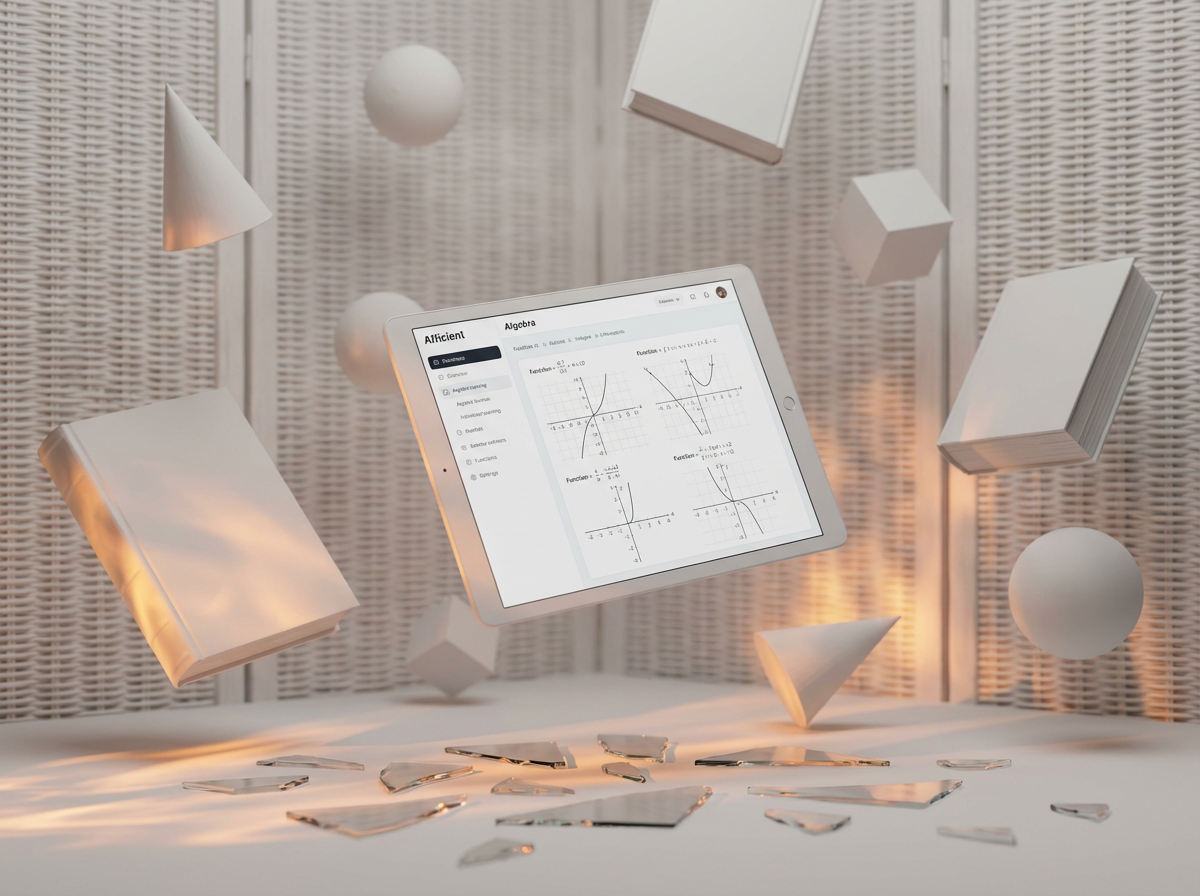
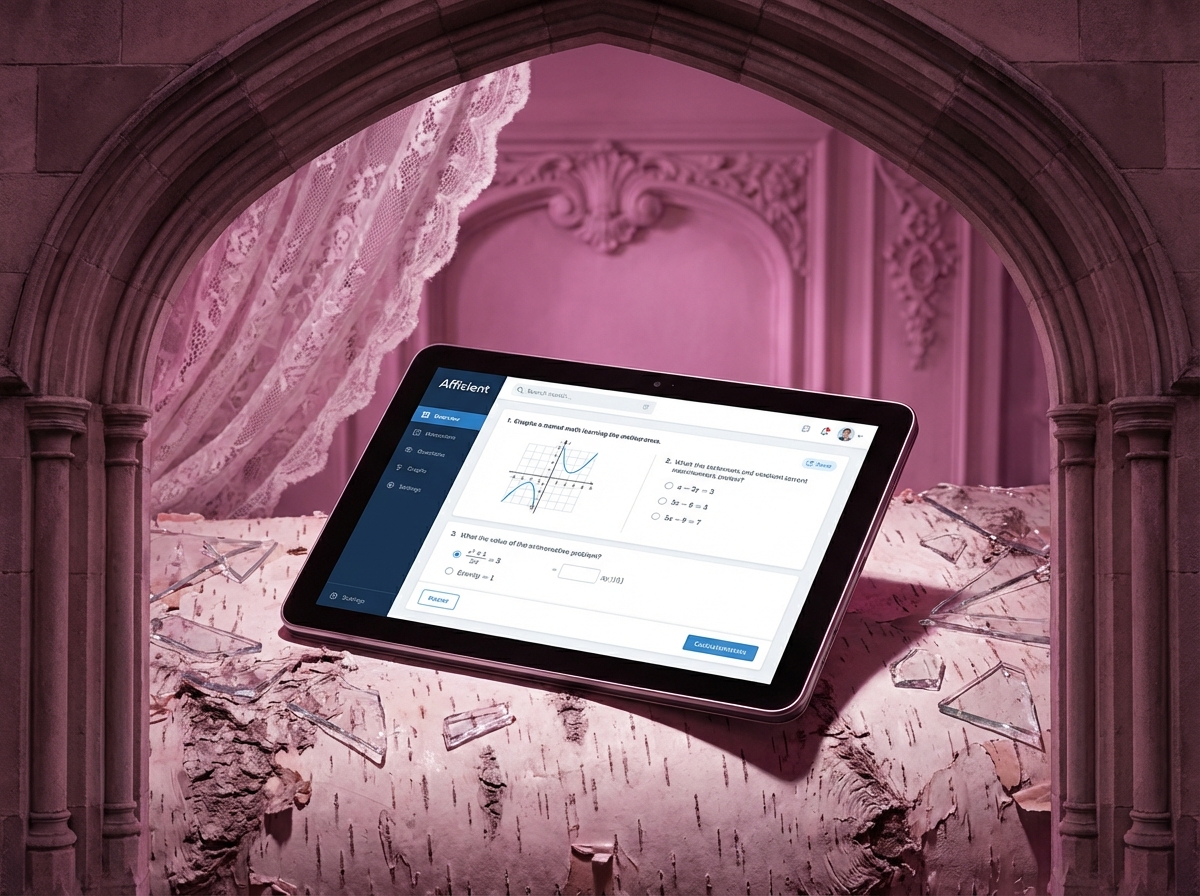
Afficient addresses this need through visual aids and multiple diagrams that show geometric concepts from different perspectives. Rather than presenting a single static image, the platform helps students explore shapes dynamically, building the spatial reasoning skills that traditional instruction often assumes students already possess.
Discover your child’s specific geometry gaps with a free diagnostic assessment that identifies exactly where understanding breaks down.
How AI Identifies Spatial Thinking Gaps
Traditional assessment focuses on whether students get the right answer. But in geometry, the path to the answer reveals far more about understanding than the answer itself. A student might correctly calculate an angle measure through lucky guessing or formula memorization while completely missing the underlying geometric relationships.
Afficient’s AI identifies spatial thinking gaps—not just calculation errors. The system analyzes how students approach problems, recognizing patterns that indicate conceptual confusion versus simple computational mistakes. This distinction matters because the remediation strategies differ dramatically.
For example, if a student consistently struggles with problems involving similar triangles, the AI determines whether the issue stems from:
- Inability to identify corresponding parts
- Confusion about proportional relationships
- Difficulty setting up equations
- Errors in algebraic manipulation
Each root cause requires different instructional support. The platform’s error pattern analysis understands why students are confused, enabling targeted intervention rather than generic review.
Breaking Down Proofs: From Intimidating to Manageable
Geometric proofs intimidate many students because they seem to require creative leaps that can’t be taught. In reality, proof construction follows recognizable patterns once students learn to identify them. The challenge lies in building the pattern recognition skills and logical reasoning habits that make proofs accessible.
Afficient provides step-by-step proof guidance that breaks down logical reasoning into manageable components. Rather than presenting a complete proof and expecting students to understand it, the system scaffolds the process:
- Identifying what’s given and what needs to be proven
- Recognizing which theorems might apply
- Planning a logical sequence of steps
- Justifying each step with appropriate reasons
- Checking that the conclusion follows from the premises
This structured approach demystifies proofs while building the logical thinking skills that extend far beyond geometry class.
Connecting Geometry to Real-World Applications
Abstract concepts become more meaningful when students see their practical applications. Geometry surrounds us—in architecture, art, engineering, sports, and nature. Making these connections explicit helps students understand why they’re learning these concepts and provides concrete contexts for abstract ideas.
Real-world connections that resonate with students:
- Architecture and structural design using geometric principles
- Computer graphics and game design relying on coordinate geometry
- Sports analytics using angles and trajectories
- Navigation systems applying distance formulas
- Art and design incorporating symmetry and transformations
When students recognize geometry in their daily lives, the subject transforms from arbitrary rules to useful tools for understanding the world.
The Afficient Approach to Geometry Mastery
Afficient’s geometry-specific advantages address the unique challenges this subject presents. The platform combines visual learning, multiple solution methods, and AI-powered analysis to create a comprehensive support system.
Multiple solution methods show students that geometry problems often have several valid approaches. A problem might be solved through pure geometric reasoning, algebraic methods, or coordinate geometry techniques. Exposure to these different pathways helps students develop flexibility in problem-solving and find approaches that match their thinking styles.
Targeted concept breakdown isolates specific geometry struggles rather than treating all difficulties as general “math problems.” The system recognizes that understanding parallel lines differs from grasping triangle congruence, which differs from mastering circle theorems. Each concept receives focused attention with appropriate visual supports and practice.
See how Afficient makes geometry click with a free evaluation that demonstrates the platform’s approach to your child’s specific challenges.
Practical Strategies for Supporting Geometry Learning at Home
Parents can support geometry learning even without advanced math knowledge. The key lies in encouraging visualization, asking questions that promote logical thinking, and providing tools that make abstract concepts concrete.
Effective home support strategies:
- Use physical manipulatives like pattern blocks or geometric solids
- Encourage drawing and sketching to visualize problems
- Ask “why” questions that promote logical reasoning
- Connect geometry to everyday observations
- Celebrate progress in understanding, not just correct answers
- Provide multiple attempts without pressure
Creating a low-stress environment where mistakes become learning opportunities helps students develop the persistence geometry requires. Many students need time to build spatial reasoning skills, and pressure often impedes this development.
Real Results: From Geometry Struggles to Success
The transformation from geometry confusion to mastery typically unfolds over two to three months of consistent, targeted practice. Students who previously avoided geometry homework begin engaging with problems confidently. Those who memorized formulas without understanding start recognizing when and why to apply different theorems.
Real results show that students master geometry in 2-3 months when they receive appropriate support that addresses their specific learning needs. The key lies in identifying exactly where understanding breaks down and providing targeted instruction that builds missing foundations while advancing new learning.
Notably, 90% of students achieve A or A+ grades even in challenging geometry when they work with systems that provide visual supports, multiple representations, and error pattern analysis. These results demonstrate that geometry struggles often reflect instructional gaps rather than inherent inability.
Taking Action: Your Next Steps
Geometry doesn’t have to be the bottleneck in your child’s math education. With the right support—visual learning tools, multiple solution methods, and AI that identifies spatial thinking gaps—students who struggle with geometry can achieve breakthrough understanding.
The first step involves identifying your child’s specific challenges. A comprehensive diagnostic assessment reveals exactly where understanding breaks down, enabling targeted support that addresses root causes rather than symptoms.
Take the free diagnostic test to identify and fix your child’s geometry struggles. Understanding the specific nature of your child’s difficulties enables you to provide the precise support they need to transform geometry from a source of frustration into an area of confidence and success.
Remember: geometry requires different thinking and different support than other math subjects. Visual learning combined with multiple methods creates the foundation for geometry success. When students receive instruction that matches how spatial reasoning develops, they don’t just pass geometry—they master it.