
I hear you – it’s incredibly frustrating when your child can recite the quadratic formula perfectly but freezes when faced with a word problem. You watch them ace the memorization quiz on Friday, only to see them struggle with the exact same concepts two weeks later. They can tell you what to do, but they can’t explain why it works. Sound familiar?
You’re not alone in this struggle. Thousands of parents face this exact challenge every day, watching their kids work harder and harder while understanding less and less. The good news? This isn’t about your child’s intelligence or effort – it’s about how they’re learning.
Why Memorization Feels Like Learning (But Isn’t)
Here’s what’s really happening in your child’s brain when they memorize without understanding. When kids memorize formulas, they’re storing information in their short-term memory – think of it as a temporary sticky note. It works great for next week’s test, but that sticky note falls off quickly. Research in cognitive science shows that memorized information without conceptual understanding fades within days or weeks.
The real problem? Your child is building a house of cards. Each new formula sits on top of previous ones they didn’t truly understand. Eventually, the whole structure collapses – usually around middle school when math concepts become more abstract and interconnected.
When students rely on memorization, they’re essentially learning a foreign language by memorizing phrases without understanding grammar. They can repeat “Where is the bathroom?” perfectly, but they can’t ask where the library is because they don’t understand how the sentence actually works.
The Science Behind Deep Mathematical Understanding
Deep mathematical understanding isn’t about being “naturally good at math” – it’s about building genuine number sense and conceptual frameworks. Think of it like learning to ride a bike. You can memorize all the steps: “pedal with your feet, hold the handlebars, look forward.” But until you actually understand balance and momentum through practice, you’ll keep falling over.
Number sense is the foundation of mathematical thinking. It’s the intuitive understanding of how numbers relate to each other, how operations work, and why certain strategies make sense. Kids with strong number sense can look at 47 + 38 and think, “That’s close to 50 + 40, so around 85” – they’re not just following a memorized algorithm.
Research shows that students who develop conceptual understanding actually learn 2-5x faster in the long run. Why? Because they’re not re-learning the same concepts over and over. When they truly understand why multiplication is repeated addition, they can apply that understanding to fractions, algebra, and beyond.
Seven Strategies to Move From Memorization to Understanding
Start With Real-World Problems That Matter
Instead of starting with the formula, start with the problem. If you’re teaching area, don’t begin with “length times width.” Start with: “We’re getting new carpet for your bedroom. How do we figure out how much to buy?”
This approach works because it gives math context and purpose. Your child isn’t just manipulating numbers – they’re solving a real problem. When they discover that they need to multiply length by width to find area, that formula becomes a tool they invented, not a rule they memorized.
Try this at home: Next time your child has math homework, ask them to explain the problem in their own words first. “What’s actually happening in this situation?” If they can’t explain it without using math terms, they’re probably memorizing, not understanding.
Use Visual Tools and Manipulatives
Abstract formulas make sense to mathematicians, but your child’s brain needs to see and touch math concepts first. This is where manipulatives – physical objects that represent mathematical ideas – become powerful learning tools.
For fractions, use pizza slices or fraction bars. For algebra, use balance scales to show equations. For geometry, use actual shapes they can measure and manipulate. The goal is to build a mental model of what’s happening mathematically.
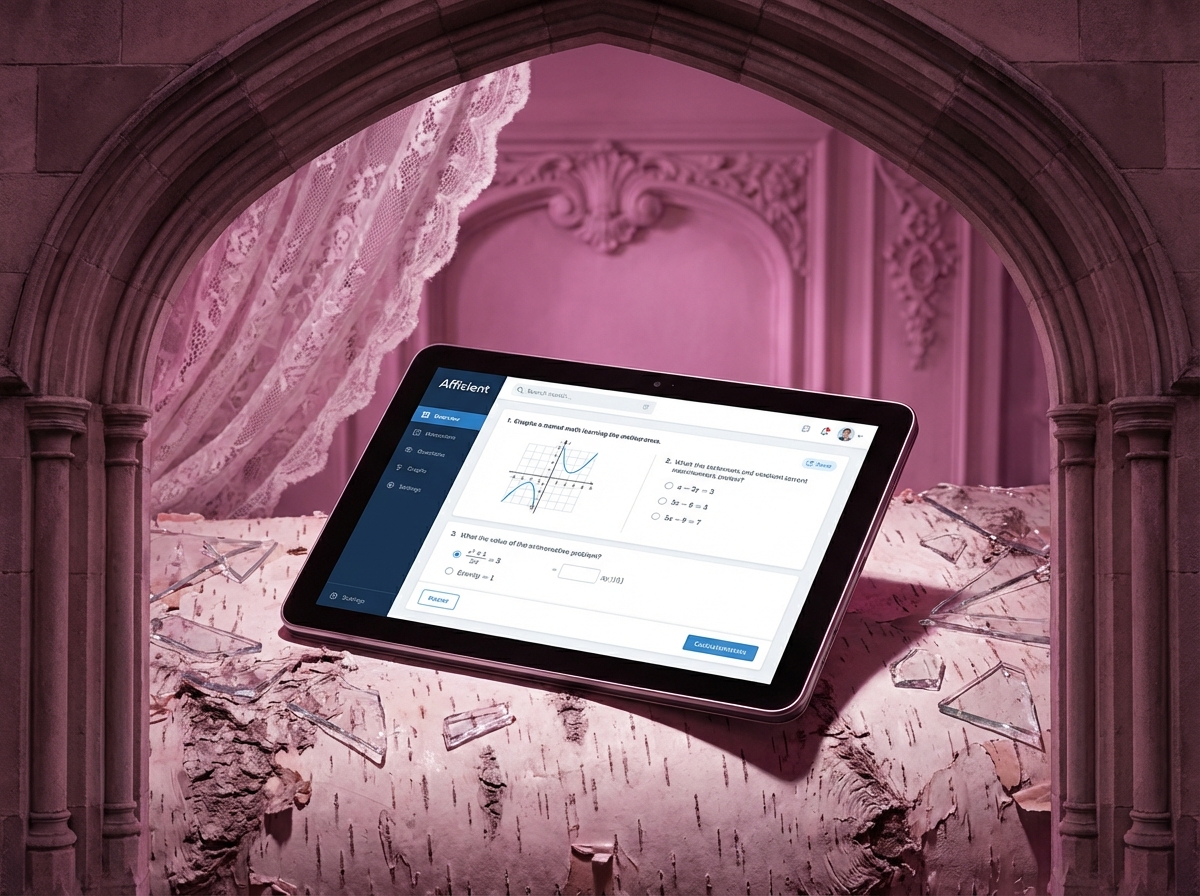
Here’s what makes Afficient different: The platform uses interactive visual representations and AI-driven adaptive learning technology. When a student struggles with a concept, the system identifies their weak points and provides targeted practice to help them progress from easier to more difficult problems. Students can’t advance until they hit 80-90% accuracy – no faking it, no moving on before they’re ready.
Encourage Multiple Solution Strategies
There’s rarely just one way to solve a math problem, but memorization teaches kids there’s only one “right” method. This is limiting and dangerous. When students learn multiple strategies, they develop flexibility in their thinking and deeper understanding of mathematical relationships.
Take 15 × 12. A memorizer plugs it into the standard algorithm. But a student with understanding might think: “15 × 10 = 150, plus 15 × 2 = 30, so 180.” Or: “That’s like 3 × 5 × 12 = 3 × 60 = 180.” Both work, and exploring different paths builds mathematical intuition.
Want to see if your child truly understands or just memorizes? Get a free diagnostic assessment that reveals exactly where conceptual gaps exist.
Foster Mathematical Dialogue and Metacognition
The most powerful question you can ask your child isn’t “What’s the answer?” It’s “How did you figure that out?” and “Why does that work?”
When kids explain their thinking out loud, they’re forced to examine their own understanding. This metacognitive process – thinking about thinking – is where deep learning happens. If they can’t explain why their method works, they don’t truly understand it yet.
Create a judgment-free zone for these conversations. When your child makes an error, don’t just correct it – ask them to walk through their reasoning. Often, they’ll catch their own mistake when they have to explain it. Even better, they’ll understand why it was a mistake, not just that it was wrong.
Build Pattern Recognition Skills
Mathematics is fundamentally about patterns and relationships. When students memorize, they miss these patterns entirely. But when they learn to recognize patterns, math becomes predictable and logical instead of arbitrary and confusing.
Help your child notice patterns in multiplication tables: “Look, every number times 9 has digits that add up to 9!” Or in fractions: “Notice how 1/2, 2/4, and 3/6 are all the same amount?” These observations build mathematical intuition that memorization never can.
Afficient’s approach to pattern recognition: The AI system identifies patterns in student errors and addresses the underlying conceptual misunderstanding, not just the surface mistake. If a student consistently struggles with word problems involving rates, the system recognizes this pattern and provides targeted practice on rate concepts, not just more word problems.
Implement Spaced Repetition With Understanding
Here’s a frustrating truth: even when kids understand a concept, they’ll forget it if they don’t revisit it regularly. But there’s a crucial difference between spaced repetition with understanding versus spaced repetition of memorized facts.
When students revisit concepts they understood deeply, they’re strengthening neural pathways and building long-term retention. When they revisit memorized formulas, they’re just re-memorizing – and they’ll forget again just as quickly.
The key is to bring back old topics in new contexts. If your child learned fractions in October, have them apply fraction concepts to probability in December. This reinforces understanding while showing how mathematical ideas connect.
The Afficient advantage: The system brings back previously mastered topics at optimal intervals so kids don’t forget. But it’s not just drilling the same problems – it presents concepts in fresh contexts that deepen understanding. Discover where your child’s conceptual gaps are with a comprehensive evaluation.
Create Collaborative Learning Experiences
When kids work together on math problems, something magical happens. They have to articulate their thinking, defend their reasoning, and consider alternative approaches. This social dimension of learning accelerates understanding in ways that solo memorization never can.
Set up study groups where students explain concepts to each other. Research shows that teaching someone else is one of the most effective ways to solidify your own understanding. When your child has to explain why the distributive property works to a peer, they’re forced to truly understand it themselves.
The Speed vs. Depth Myth
You might be thinking: “This all sounds great, but won’t deep understanding take much longer? My child is already behind!”
Here’s the counterintuitive truth: students who build deep understanding actually learn faster in the long run. Yes, it might take an extra week to truly master fractions instead of just memorizing the rules. But that student won’t need to re-learn fractions three more times throughout the year. They won’t freeze on the test. They won’t need remediation in high school.
Real results from Afficient students: Over 90% of students improve by one grade level within 2-5 months and achieve A/A+ grades – that’s not just higher scores, that’s genuine understanding that sticks. Students advance a full grade level because they’ve mastered the concepts, not just memorized enough to pass.
Practical Steps You Can Take Today
Start tonight at homework time. When your child shows you their math work, don’t just check if the answers are right. Ask:
- “Can you explain this problem in your own words?”
- “Why did you choose that method?”
- “Could you solve it a different way?”
- “Where have we seen this type of problem before?”
If they struggle to answer these questions, you’ve identified a memorization gap. That’s actually good news – now you know where to focus.
Use everyday situations to build number sense. At the grocery store: “These apples are $3 per pound. About how much will 2.3 pounds cost?” In the car: “We’ve driven 45 minutes of a 2-hour trip. What fraction of the trip is left?”
Most importantly, celebrate understanding over correct answers. When your child solves a problem incorrectly but can explain their logical reasoning, praise that reasoning. When they get the right answer but can’t explain why, dig deeper.
The Long-Term Impact of True Understanding
Students who develop genuine mathematical understanding don’t just get better grades – they develop problem-solving skills that transfer to every area of life. They learn to break down complex problems, recognize patterns, think logically, and persist through challenges.
These students don’t say “I’m just not a math person.” They say “I haven’t figured this out yet.” That growth mindset comes from experiencing the satisfaction of truly understanding something difficult, not from memorizing their way to a passing grade.
The difference between memorization and understanding is the difference between renting and owning knowledge. Memorized facts are borrowed – they have to be returned (forgotten) eventually. But understood concepts are owned – they’re yours forever, and you can build on them indefinitely.
Moving Forward: From Formulas to Foundations
Your child’s struggle with memorization versus understanding isn’t a character flaw or a learning disability – it’s a signal that they need a different approach. The good news is that it’s never too late to build genuine mathematical understanding, even if they’ve been memorizing for years.
The strategies outlined here – real-world problems, visual tools, multiple solution paths, mathematical dialogue, pattern recognition, spaced repetition, and collaborative learning – work together to create a comprehensive approach to deep learning. You don’t have to implement all of them at once. Start with one or two that resonate with your child’s learning style.
Remember: the goal isn’t to make math easy. The goal is to make math make sense. When concepts click into place, when your child has that “aha!” moment of genuine understanding, that’s when learning accelerates. That’s when math transforms from a series of arbitrary rules to memorize into a logical system that makes sense.
Take the free diagnostic test to see exactly what your child understands versus what they’ve just memorized. You’ll get a clear picture of where the conceptual gaps are and a personalized roadmap for building genuine understanding.
Your child can move from memorizing formulas to truly understanding mathematics. It starts with recognizing the difference – and you’ve already taken that crucial first step by reading this article. Now it’s time to put these strategies into action and watch your child’s confidence and competence grow together.