
Advanced middle school students face a unique challenge in mathematics education. While their peers struggle with grade-level content, these exceptional learners breeze through assignments, often finishing in minutes what takes others an entire class period. The result? Boredom, disengagement, and a dangerous pattern of underachievement that can follow them for years.
The gifted learner’s dilemma is real and urgent. When mathematically talented students aren’t challenged appropriately, they develop poor work habits, lose motivation, and may never reach their true potential. Traditional classroom settings, even honors or accelerated tracks, often cap learning at predetermined grade levels—leaving advanced students waiting for their peers to catch up.
The Critical Problem with Traditional Gifted Math Programs
Most parents of advanced learners have encountered the same frustrating scenario: their child completes the regular math curriculum months ahead of schedule, only to be given “enrichment” activities that feel like busywork. Even specialized gifted programs often impose artificial ceilings on learning progression.
Consider the typical limitations:
Traditional gifted programs offer excellent curriculum but may follow fixed schedules with predetermined lesson sequences. Students must attend classes at specific times, regardless of whether they’ve already mastered the material or need more time on challenging concepts. Beast Academy, while engaging for younger learners, focuses on elementary-level content.
Russian School of Mathematics (RSM) is known for rigorous instruction with structured class formats. For families without convenient access or students with busy schedules, this creates significant barriers. CTY (Center for Talented Youth) offers prestigious programs with selective admission processes.
The fundamental issue: These programs impose structure where advanced learners need flexibility. They create ceilings where exceptional students need unlimited growth potential.
What Advanced Middle School Students Actually Need
Gifted mathematics students require fundamentally different learning conditions than their grade-level peers. Understanding these needs is crucial for parents seeking the right educational path.
Unlimited ceiling for intellectual growth. An 8-year-old capable of understanding algebraic concepts shouldn’t be held back by grade-level expectations. A 6th grader ready for calculus shouldn’t wait until high school. Advanced learners need programs that adapt upward without artificial limits.
True self-paced progression. “Self-paced” shouldn’t mean “work through predetermined modules at your own speed.” It should mean advancing as rapidly as mastery allows—whether that’s completing two years of content in six months or spending extra time on particularly challenging concepts.
Deep, challenging content that engages. Advanced students don’t just need harder problems; they need mathematically rich content that develops genuine problem-solving skills, mathematical reasoning, and creative thinking. Surface-level difficulty increases won’t sustain engagement.
Flexibility to explore mathematical interests. Some students gravitate toward competition mathematics, others toward pure theory, and still others toward applied problem-solving. The best programs allow students to pursue their mathematical passions while building comprehensive skills.
Recognition and validation of abilities. Advanced learners need environments that acknowledge their capabilities without making them feel isolated or different. They benefit from connecting with intellectual peers while progressing at their own pace.
Discover your child’s true potential with our advanced diagnostic assessment that identifies exactly where your student stands and how far they can go.
How Afficient Removes Learning Limits for Advanced Students
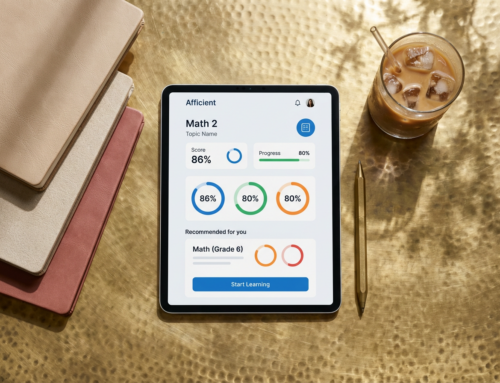
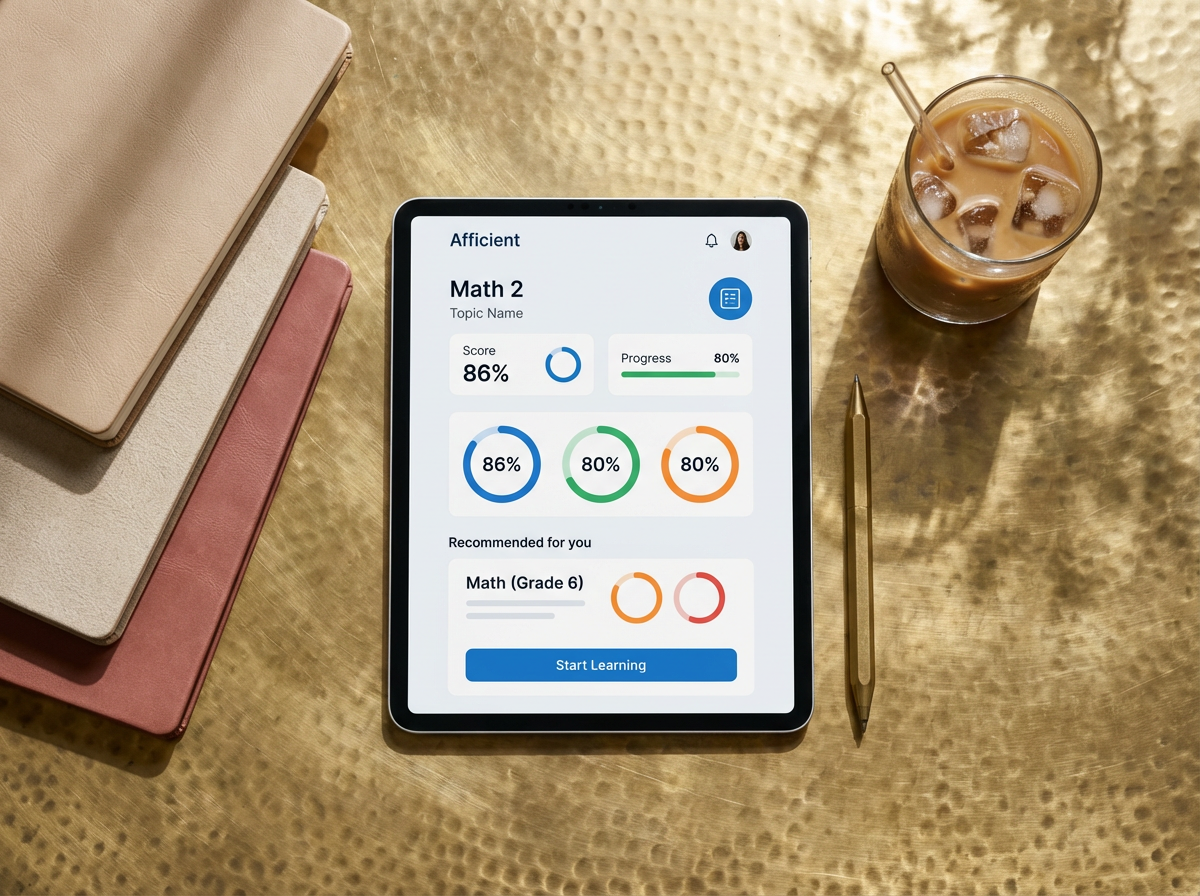
Afficient represents a fundamental shift in how advanced mathematics education works. Rather than fitting students into predetermined curricula, the platform adapts infinitely to each learner’s demonstrated abilities.
No upper limit on advancement. The AI-powered system doesn’t recognize grade levels as boundaries. Elementary students regularly work through high school algebra. Middle schoolers tackle calculus concepts. The platform continuously adjusts difficulty based on performance, creating an endless ladder of appropriate challenge. Real students on Afficient demonstrate this daily: 8-year-olds mastering algebraic thinking, 6th graders working through geometry proofs, 7th graders exploring calculus foundations.
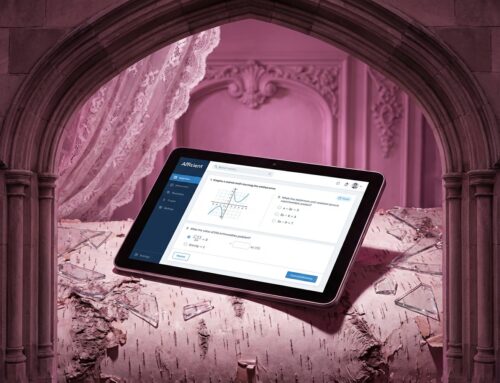
Genuine self-pacing with intelligent adaptation. Unlike fixed-curriculum programs, Afficient doesn’t just let students move faster through predetermined content. The AI generates custom problem sets tailored to each student’s current mastery level, learning style, and areas needing reinforcement. Students advance when they demonstrate true understanding, not when they complete a set number of exercises.
Hyper-personalized challenge levels. The platform’s AI creates problems specifically calibrated to each student’s zone of proximal development—challenging enough to engage but not so difficult as to frustrate. This dynamic adjustment happens continuously, ensuring students remain in the optimal learning state.
Complete scheduling flexibility. Advanced learners often have demanding schedules filled with competitions, extracurriculars, and other academic pursuits. Afficient works anytime, anywhere, without fixed class times or rigid schedules. Students can complete a lesson at 6 AM before school, during lunch break, or late evening—whatever fits their lifestyle.
Acceleration that matches ability. The platform enables significant acceleration compared to traditional grade-level progression. This isn’t about rushing through content—it’s about removing artificial speed limits for students capable of faster mastery. Students spend time on concepts that challenge them and move quickly through material they grasp readily.
Continuous engagement tracking. The AI monitors not just correctness but engagement patterns, time spent on problems, and approach strategies. This ensures students remain challenged without becoming frustrated, maintaining the delicate balance that keeps advanced learners motivated.
See how far your advanced learner can go with our free evaluation that maps their current abilities and potential growth trajectory.
Comparing Approaches: Fixed Programs vs Adaptive Learning
Understanding the fundamental differences between traditional gifted programs and adaptive platforms helps parents make informed decisions.
AOPS and Beast Academy offer carefully designed curricula with engaging problems and strong pedagogical foundations. However, both follow predetermined sequences. Students must wait for scheduled classes, work through fixed lesson progressions, and often encounter content they’ve already mastered. Beast Academy’s grade-level cap means middle schoolers outgrow the program entirely.
RSM provides excellent instruction with proven results in competition mathematics. The in-person format offers valuable peer interaction but requires significant time commitments and geographic proximity. Students must attend classes at specific times regardless of their mastery level or schedule constraints.
CTY delivers prestigious programs with strong academic credentials. However, limited availability, competitive admissions, and premium pricing make it inaccessible for many families. The fixed summer schedule doesn’t support year-round learning or flexible pacing.
Afficient takes a fundamentally different approach. Rather than fitting students into existing structures, it builds custom learning paths for each individual. The platform combines unlimited advancement potential with complete flexibility, making elite-level mathematics education accessible to any student with ability and motivation—regardless of location, schedule, or budget constraints.
Addressing Common Concerns About Unlimited Learning
Parents of gifted students often have legitimate questions about programs promising unlimited advancement.
“Will it really be challenging enough for my advanced child?” The AI continuously adjusts difficulty based on demonstrated performance. As students master concepts, the platform introduces more sophisticated problems, deeper theoretical understanding, and complex applications. There’s no ceiling—students who exhaust standard curricula move into competition-level problems, proof-based mathematics, and advanced topics typically reserved for high school or college.
“Can they truly advance without limits, or will they hit a wall?” The platform offers content across multiple mathematics levels. Students progress based on mastery, not age or grade level. The AI ensures proper foundation-building while enabling rapid advancement through material students grasp quickly.
“How do you prevent boredom while ensuring mastery?” The system balances challenge and success by maintaining problems in each student’s optimal difficulty zone. If a student breezes through content, difficulty increases immediately. If they struggle, the AI provides targeted support and practice. This dynamic adjustment prevents both boredom from excessive ease and frustration from excessive difficulty.
“What about social interaction and peer learning?” While Afficient focuses on individualized learning, advanced students often benefit from working independently at their own pace rather than waiting for group instruction. The platform’s flexibility allows students to participate in other mathematical communities, competitions, and peer activities on their own schedule.
“Is this approach better than traditional gifted programs?” For students who need unlimited advancement potential, complete scheduling flexibility, and truly personalized challenge levels, adaptive AI-powered learning offers advantages traditional programs cannot match. For students who thrive in structured classroom environments with fixed schedules, traditional programs may better suit their learning style. The key is matching the approach to the individual student’s needs.
Guidance for Parents of Mathematically Advanced Students
Selecting the right mathematics program for your gifted child requires understanding their specific needs, learning style, and goals.
Assess your child’s current level honestly. Advanced students often work several grade levels ahead in some areas while having gaps in others. A comprehensive diagnostic assessment reveals true strengths and areas needing development, enabling appropriate program selection.
Consider scheduling and lifestyle factors. Does your family’s schedule accommodate fixed class times? Is geographic proximity to in-person programs feasible? Does your child prefer structured schedules or flexible learning? These practical considerations significantly impact program success.
Evaluate advancement potential. Will the program allow your child to progress as far as their abilities allow, or will they hit artificial ceilings? Programs with grade-level caps may work initially but leave advanced students without clear next steps.
Examine cost and accessibility. Premium programs deliver excellent results but may strain family budgets. More accessible options can provide comparable learning outcomes for motivated students. Consider long-term costs as your child advances through multiple years of mathematics.
Prioritize engagement and motivation. The best program is one your child will actually use consistently. Advanced students need intellectual challenge to stay engaged. Programs that adapt to maintain optimal difficulty levels typically sustain motivation better than fixed-difficulty curricula.
Look for comprehensive skill development. Competition success, advanced placement, and college preparation all require different skill emphases. The ideal program builds broad mathematical competence while allowing students to pursue specific interests.
Take the free diagnostic test to unlock unlimited learning potential for your gifted child and discover exactly where they stand and how far they can advance.
The Future of Advanced Mathematics Education
The landscape of gifted mathematics education is evolving rapidly. Traditional models built around fixed curricula and scheduled classes are giving way to adaptive, personalized approaches that recognize each student’s unique abilities and needs.
For advanced middle school students, this shift means unprecedented opportunities. No longer constrained by grade-level expectations or artificial progression limits, mathematically talented students can explore the full depth and breadth of mathematics at their own pace. The combination of AI-powered personalization and unlimited content access creates learning environments that truly match exceptional abilities.
Afficient exemplifies this new paradigm—removing the ceilings that have historically limited gifted learners while maintaining the rigor and depth they need to develop genuine mathematical expertise. By combining unlimited advancement potential with complete flexibility and intelligent adaptation, the platform makes elite mathematics education accessible to any student with ability and motivation.
The question for parents is no longer whether their advanced child can access challenging mathematics education, but rather which approach best matches their individual needs. For students who need to break free from traditional constraints and advance as far as their abilities allow, adaptive AI-powered learning offers a compelling path forward—one without artificial limits, fixed schedules, or predetermined endpoints.
Your child’s mathematical potential is unlimited. Their learning environment should be too.