
Your child’s report card is coming, and you need results fast. Not in six months. Not next semester. Now.
I understand the pressure you’re facing. Traditional tutoring promises improvement “over time,” but when your middle schooler is struggling with fractions while the class moves on to algebra, waiting months isn’t an option. You need a method that works quickly without sacrificing quality—and fortunately, research shows exactly how to achieve this.
Why Traditional Methods Take Too Long
Most parents instinctively reach for more practice worksheets or weekly tutoring sessions. The problem? These approaches waste precious time on content your child already knows while missing the specific gaps holding them back.
Generic tutoring typically requires 6-12 months to show meaningful improvement because it follows a one-size-fits-all curriculum. Your child sits through explanations of concepts they’ve already mastered, then rushes through topics where they actually need help. It’s like trying to fill a leaky bucket—you’re adding water, but the fundamental holes remain.
The time-wasting cycle looks like this: Your child attends a weekly tutoring session covering broad topics. They practice problems at home, some too easy, some impossibly hard. Frustration builds. Confidence drops. Weeks pass with minimal progress because the real issue—those specific knowledge gaps from earlier grades—never gets addressed.
The Science of Accelerated Math Learning
Recent educational research reveals why some students improve dramatically in weeks while others struggle for months. The difference isn’t intelligence or effort—it’s precision.
High-impact learning requires three elements working together: First, pinpoint identification of exactly what your child doesn’t know. Not “struggling with fractions,” but specifically “doesn’t understand equivalent fractions with unlike denominators.” Second, targeted practice on only those gaps, eliminating wasted time on mastered material. Third, immediate feedback that prevents practicing mistakes.
Research demonstrates that high-impact tutoring—sessions occurring 3+ times weekly for 20-30 minutes—can generate the equivalent of months of additional math learning outcomes within a single year. But here’s the critical insight: frequency matters less than precision. Three unfocused hours accomplish less than 30 focused minutes on the right content.
Spaced repetition transforms learning speed. Studies show that spaced practice—distributing practice across multiple days rather than concentrated cramming—can improve math test scores by over 50%. When your child practices the same concept for 15 minutes across four days instead of one 60-minute session, their brain consolidates the information more effectively. This isn’t about working harder—it’s about working smarter.
Interleaved practice accelerates mastery. Mixing old and new problem types during each session forces the brain to actively retrieve information rather than passively recognize patterns. Students using this method demonstrate significantly higher performance on assessments compared to those practicing one topic at a time.
How Afficient Delivers 2-5x Faster Results
This is where Afficient Academy’s approach fundamentally differs from traditional tutoring. The platform’s patented AI technology creates personalized learning paths unique to each student.
Here’s what happens in the first week: Your child takes a comprehensive diagnostic assessment. Within minutes, Afficient’s AI identifies every knowledge gap from 1st grade through their current level. Not general weaknesses—specific missing concepts like “multiplying decimals” or “solving two-step equations.”
The acceleration begins immediately. Instead of starting with current grade-level material and hoping for the best, Afficient’s system automatically fills knowledge gaps from earlier grades first, then advances to middle school topics. If your 7th grader never fully mastered fraction operations in 5th grade, the system addresses that precise gap with targeted exercises—then immediately advances to the next concept. No time wasted reviewing what they already know.
Real-time adaptation maintains optimal challenge. The AI continuously adjusts difficulty based on performance, keeping your child in what researchers call the “zone of proximal development”—not so easy they’re bored, not so hard they’re overwhelmed. This dynamic adjustment is why Afficient students progress 2-5x faster than traditional methods.
Immediate feedback eliminates wasted practice. Every problem provides instant correction with step-by-step explanations. Your child never practices incorrect methods for days before discovering their mistake. This alone saves weeks of unlearning bad habits.
The timeline for visible results: Most Afficient students show measurable improvement within 2-3 weeks. Complete grade-level catch-up typically occurs in 2-3 months—not the 6-12 months traditional tutoring requires. Internal data shows that many students complete an entire grade’s worth of math curriculum and achieve A/A+ mastery levels within several months.
Consider Sarah’s experience: An 8th grader struggling with C grades, she started Afficient in October. The diagnostic revealed gaps in fraction operations and basic algebra concepts. By focusing exclusively on those gaps with 20-minute daily sessions, Sarah caught up to grade level by December and finished the semester with an A. Eight weeks. Not eight months.
Fast Doesn’t Mean Superficial
Parents often worry that accelerated learning means rushing through material without true understanding. This concern is valid—cramming for tests produces temporary scores, not lasting knowledge.
Afficient’s acceleration comes from efficiency, not shortcuts. The platform requires mastery before advancement. Your child can’t move to the next concept until they demonstrate consistent understanding of the current one. This mastery-based progression ensures no gaps remain to slow future learning.
The 90% A/A+ achievement rate proves the quality. When students complete Afficient’s curriculum, 90% achieve A or A+ grades on assessments. This isn’t grade inflation—it’s the result of systematic gap-filling combined with adaptive practice that builds genuine understanding.
Spaced repetition builds long-term retention. The system automatically schedules review sessions for previously mastered concepts, preventing the forgetting that plagues traditional learning. Your child doesn’t just learn faster—they remember longer.
Your Action Plan for This Week
You don’t need to wait for the perfect moment to start. Here’s what to do immediately:
Day 1-2: Get the diagnostic. Take Afficient’s free diagnostic test to identify your child’s specific gaps. This assessment takes 30-45 minutes and provides a detailed roadmap of exactly what needs attention. Don’t waste another week guessing—know precisely where to focus.
Day 3-4: Establish the routine. Schedule 20-25 minutes daily for focused math practice. Research shows that spaced repetition practice—4-6 days per week for 15-25 minutes each—is among the fastest methods to improve middle school math performance. Morning before school or right after homework works best—when your child’s mind is fresh, not exhausted.
Day 5-7: Track early wins. Monitor which concepts your child masters in the first week. These quick victories build confidence and momentum. Share progress with your child: “You’ve mastered three new concepts this week—that’s faster than one per month in traditional tutoring.”
Set specific short-term goals. Instead of vague aims like “get better at math,” target concrete achievements: “Master fraction multiplication by next Friday” or “Complete the decimals unit by month-end.” Specific goals with clear deadlines create urgency and focus.
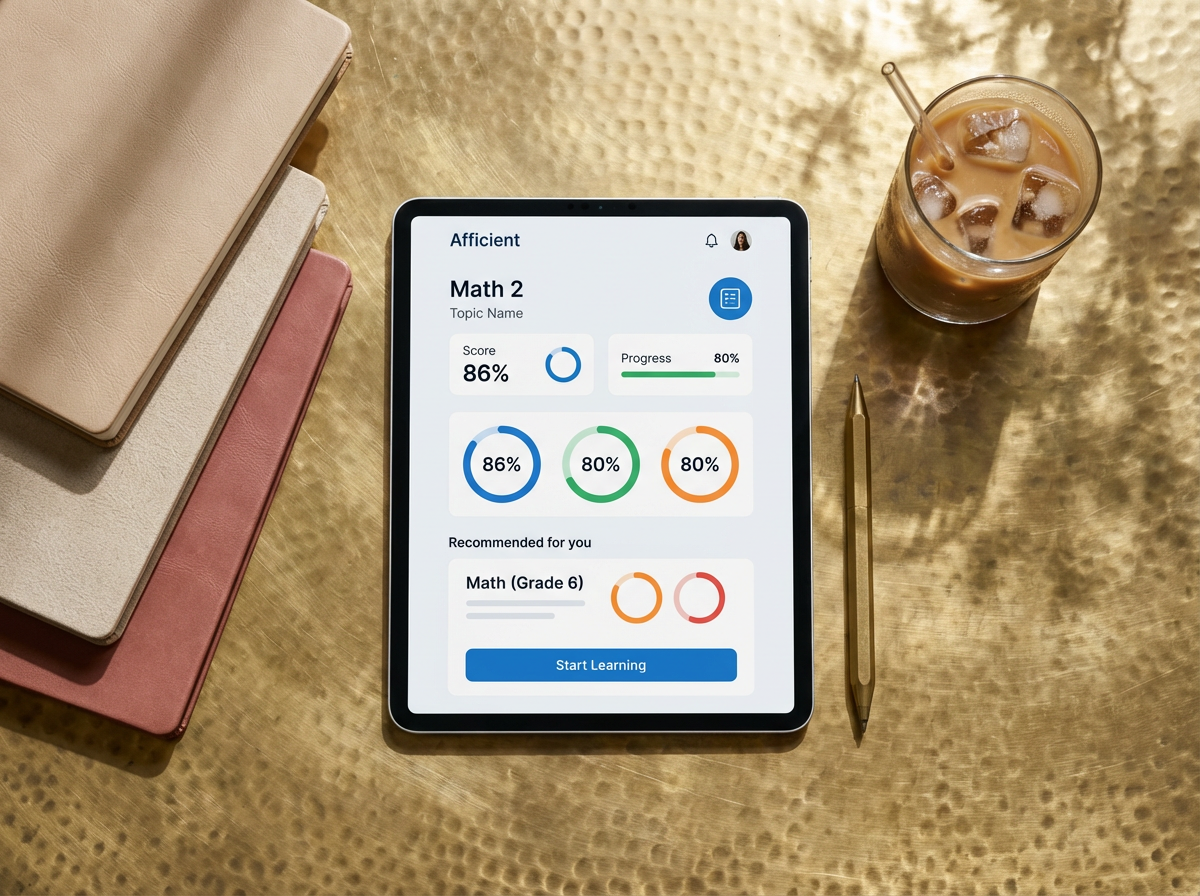
Use visualization tools. Afficient provides progress dashboards showing exactly how many concepts your child has mastered and how close they are to grade-level proficiency. Review this together weekly to maintain motivation.
When to Expect Results
Week 1-2: Confidence boost. Your child will notice they’re actually understanding concepts that previously confused them. This psychological shift is crucial—math anxiety decreases when students experience success.
Week 3-4: Grade improvement begins. Quiz and homework scores start rising as foundational gaps get filled. Teachers often notice increased class participation as your child feels more prepared.
Week 6-8: Significant progress. Most students show measurable advancement on standardized assessments. If your child was performing below grade level, they’re now approaching or reaching it.
Month 3: Grade-level mastery. The majority of Afficient students achieve full grade-level proficiency within 2-3 months of consistent use. Some advance beyond their current grade, building a buffer for future success.
The Cost of Waiting
Every week your child struggles with math, the gap widens. Next month’s algebra unit builds on this month’s fractions. Next year’s geometry requires this year’s equation-solving skills. Mathematical knowledge is cumulative—gaps compound.
But here’s the encouraging truth: With the right approach, catching up happens faster than falling behind. Precision targeting eliminates the wasted time that makes traditional methods slow. Adaptive technology provides the individualized attention that one teacher managing 30 students cannot.
Your child doesn’t need more hours of generic practice. They need the right practice, on the right concepts, at the right difficulty level, with immediate feedback. That’s how students improve in weeks instead of months.
Take the First Step Today
Every day counts when you need fast improvement. The difference between starting today and starting next month could be the difference between your child catching up this semester or falling further behind.
Start your child’s accelerated learning today__ with Afficient’s free assessment and consultation.__ You’ll receive a detailed analysis of your child’s current level, specific gap identification, and a personalized learning plan showing exactly how long catch-up will take.
The diagnostic is free. The consultation is free. The only cost is the time you’ve already lost waiting for traditional methods to work.
Your child’s math success doesn’t require months of struggle. With precision targeting, adaptive practice, and proven learning science, improvement happens in weeks, not months. The question isn’t whether your child can catch up—it’s how quickly you want it to happen.
Take the free diagnostic test now__ and see results in weeks.__ Because when it comes to your child’s education, fast and thorough aren’t opposites—they’re exactly what Afficient delivers.