Geometry stands apart from other branches of mathematics. While your child might breeze through algebra or excel at arithmetic, geometry presents a fundamentally different challenge—one that requires spatial thinking, visual reasoning, and logical proof construction. If your child is struggling with geometry, you’re not alone. This subject represents one of the most common academic bottlenecks in middle and high school mathematics, affecting students who otherwise perform well in other areas.
Understanding Why Geometry Is Uniquely Challenging
Geometry demands a different type of mathematical thinking. Unlike algebra, which relies heavily on symbolic manipulation and procedural steps, geometry requires students to visualize shapes, understand spatial relationships, and construct logical arguments. This shift in cognitive demands catches many students off guard.
The challenge begins with spatial reasoning. Students must mentally rotate objects, understand three-dimensional representations on two-dimensional paper, and recognize how different views of the same shape relate to each other. For students whose strengths lie in sequential, step-by-step problem solving, this spatial component can feel overwhelming.
Proofs introduce an entirely new dimension of difficulty. Geometry is often the first time students encounter formal mathematical reasoning. They must learn to construct logical arguments, apply theorems correctly, and justify each step of their thinking. This requires not just understanding concepts but also developing the ability to think like a mathematician—a skill that doesn’t come naturally to everyone.
Multiple representation needs compound the difficulty. A single geometry problem might require students to work with diagrams, equations, coordinate systems, and written explanations simultaneously. Students must translate between these different representations fluently, understanding how a visual diagram connects to an algebraic equation or how a coordinate proof relates to a synthetic geometry approach.
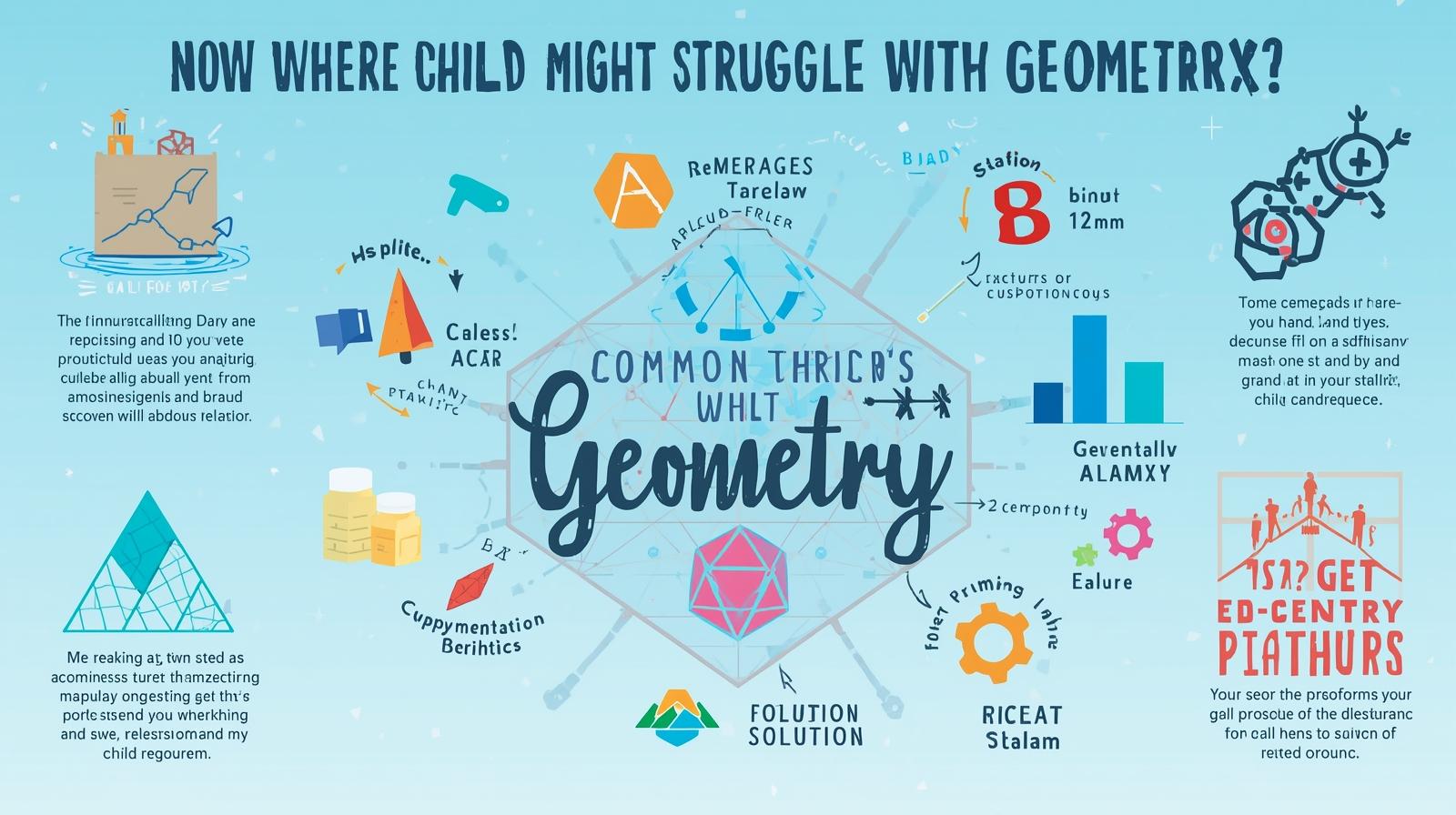
Common Geometry Struggles and Their Root Causes
Visualization difficulties affect a significant portion of students. When asked to imagine how a shape looks from a different angle or to mentally construct a three-dimensional object from its two-dimensional projections, many students simply cannot form these mental images. This isn’t a matter of effort or intelligence—some brains are naturally better wired for spatial tasks than others.
Theorem application presents another major hurdle. Geometry involves dozens of theorems, postulates, and properties. Students must not only memorize these rules but also recognize when and how to apply them. The challenge lies in pattern recognition: identifying which theorem applies to a given situation requires experience and practice that many students lack.
Proof construction remains the most intimidating aspect of geometry for most students. Writing a proof requires planning, logical sequencing, and the ability to see the end goal while working through intermediate steps. Students often know individual facts but struggle to connect them into a coherent argument. They might understand that two triangles are congruent but cannot articulate the logical steps that prove this congruence.
Word problems with diagrams combine multiple challenges. Students must extract relevant information from text, translate it into a visual representation, identify the appropriate geometric principles, and then solve the problem. Each step introduces potential points of failure, and struggling students often get stuck before they even begin the mathematical work.
Effective Strategies for Geometry Success
Visual learning approaches form the foundation of geometry mastery. Students need exposure to multiple visual representations of the same concept. Seeing a theorem illustrated in different contexts helps build the pattern recognition necessary for application. Interactive diagrams, physical models, and dynamic geometry software can transform abstract concepts into tangible understanding.
Multiple representation methods help students build connections between different ways of thinking about geometry. A student who struggles with synthetic proofs might find coordinate geometry more intuitive. Another student might understand transformations better through algebraic descriptions than through visual diagrams. Providing multiple pathways to the same concept ensures that every student can find an approach that resonates with their learning style.
Step-by-step proof strategies break down the intimidating task of proof writing into manageable components. Students benefit from explicit instruction in proof planning: identifying what needs to be proven, listing relevant theorems, and working backward from the conclusion. Templates and frameworks provide scaffolding that students can gradually remove as they gain confidence.
Connecting geometry to real-world applications increases engagement and understanding. When students see how geometric principles apply to architecture, art, engineering, or nature, abstract concepts become concrete. This contextualization helps students remember theorems and understand why geometric relationships matter.
Building spatial reasoning skills requires dedicated practice. Activities like mental rotation exercises, perspective drawing, and three-dimensional modeling strengthen the cognitive abilities that geometry demands. These skills develop over time with consistent, targeted practice.
How Afficient Addresses Geometry-Specific Challenges
Discover your child’s specific geometry gaps with our free diagnostic assessment that identifies exactly where spatial thinking breaks down and which geometric concepts need reinforcement.
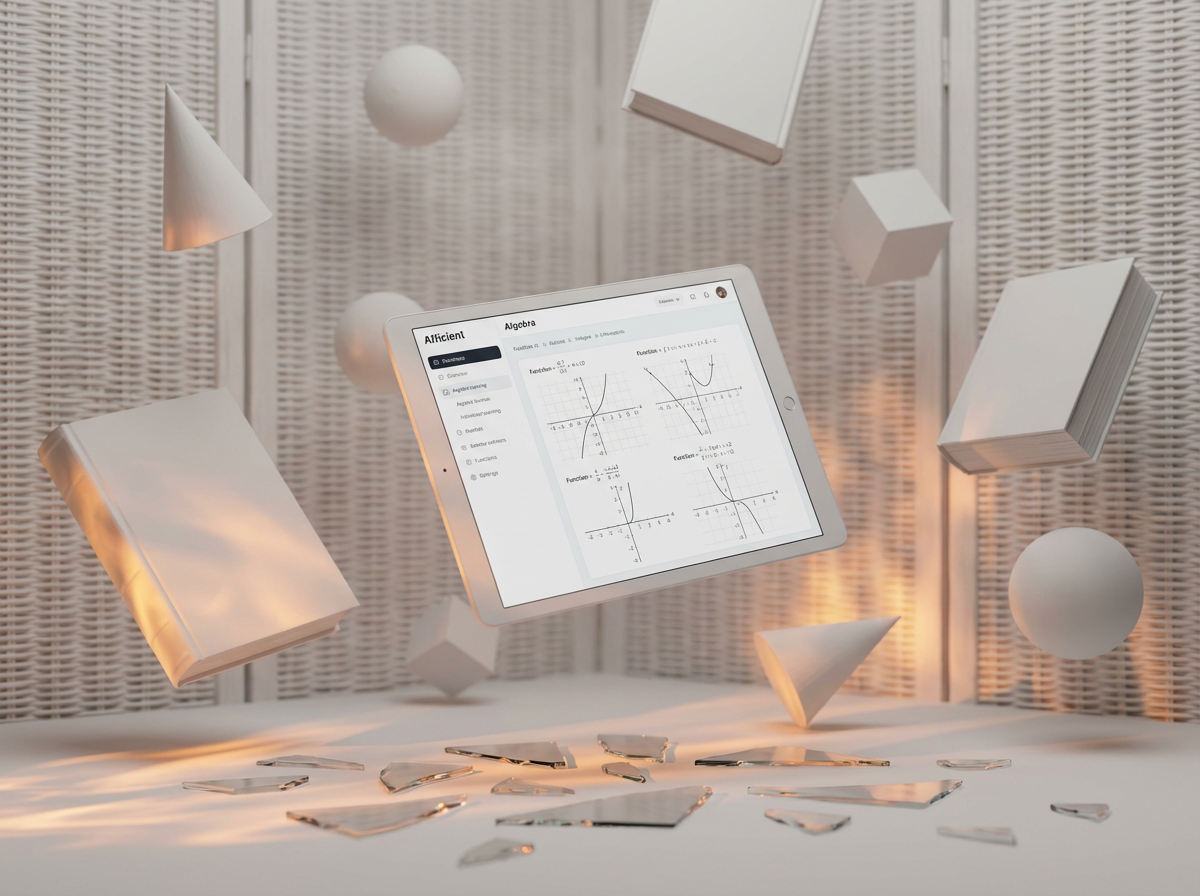
Afficient’s approach recognizes that geometry requires specialized support. The platform provides visual aids and multiple diagrams that allow students to see concepts from different angles. This multi-perspective approach helps students develop the spatial reasoning that geometry demands.
AI-powered analysis identifies spatial thinking gaps—not just calculation errors. When a student struggles with a geometry problem, Afficient’s system determines whether the issue stems from visualization difficulties, theorem misapplication, logical reasoning gaps, or computational mistakes. This precise diagnosis enables targeted intervention.
Multiple solution methods give students flexibility in their approach. Afficient presents algebraic, geometric, and coordinate approaches to the same problem, allowing students to choose the method that makes most sense to them. This flexibility respects different learning styles while ensuring students understand the underlying concepts.
Step-by-step proof guidance breaks down logical reasoning into digestible pieces. Rather than presenting complete proofs, Afficient walks students through the thinking process: identifying given information, determining what needs to be proven, selecting relevant theorems, and constructing logical arguments. This scaffolded approach builds proof-writing skills systematically.
Error pattern analysis goes beyond identifying wrong answers. Afficient’s AI understands why students make specific mistakes in geometry. Does the student consistently misapply the Pythagorean theorem? Do they struggle with angle relationships in parallel lines? This understanding enables personalized instruction that addresses root causes rather than symptoms.
Targeted concept breakdown isolates specific geometry struggles. If a student understands basic triangle properties but struggles with triangle congruence proofs, Afficient focuses instruction on that specific gap. This precision prevents wasted time reviewing concepts the student has already mastered.
See how Afficient makes geometry click with our free evaluation that demonstrates how personalized, visual instruction transforms geometry struggles into mastery.
Afficient provides personalized support for geometry-specific challenges through its AI-powered platform and visual learning approaches.
Practical Steps for Parents
Acknowledge that geometry is different. Your child’s struggle doesn’t reflect overall mathematical ability. Many students who excel at algebra find geometry challenging, and vice versa. Understanding this distinction helps reduce frustration and anxiety.
Focus on visualization skills. Encourage activities that build spatial reasoning: puzzles, building projects, drawing, and even video games that involve spatial navigation. These activities strengthen the cognitive abilities that geometry requires.
Emphasize understanding over memorization. While students need to know theorems, rote memorization without understanding leads to application difficulties. Ensure your child can explain why theorems work, not just recite them.
Provide multiple resources. Different explanations resonate with different students. If one textbook’s approach doesn’t work, try another resource. Video tutorials, interactive software, and hands-on activities offer alternative pathways to understanding.
Celebrate small victories. Geometry mastery builds gradually. Recognize progress in specific areas—successfully completing a proof, correctly applying a theorem, or accurately visualizing a three-dimensional shape—even if overall grades haven’t improved yet.
Seek specialized support. Generic math tutoring often fails with geometry because tutors may not recognize the subject’s unique challenges. Look for resources specifically designed to address spatial reasoning, proof construction, and visual learning in geometry.
The Path Forward
Geometry doesn’t have to be the bottleneck in your child’s mathematical education. With the right support, strategies, and tools, students can develop the spatial reasoning and logical thinking that geometry demands. The key lies in recognizing that geometry requires different thinking—and different support—than other mathematical subjects.
Visual learning combined with multiple solution methods creates the foundation for geometry success. When AI technology identifies spatial thinking gaps rather than just wrong answers, intervention becomes precise and effective. Students move from failing geometry to mastering proofs, from confusion about theorems to confident application of geometric principles.
The transformation happens through systematic, targeted instruction that addresses each student’s specific challenges. Whether the struggle involves visualization, proof construction, theorem application, or logical reasoning, personalized support makes geometry accessible and even enjoyable.
Take the free diagnostic test to identify and fix your child’s geometry struggles with a comprehensive evaluation that pinpoints exactly where support is needed and demonstrates how targeted instruction can transform geometry from a source of frustration into an area of strength.
Your child’s geometry struggle is real, common, and solvable. With understanding, appropriate strategies, and specialized support from platforms like Afficient, students master the spatial thinking and logical reasoning that geometry demands. The subject that once seemed impossibly abstract becomes clear, logical, and even fascinating. From struggling with basic concepts to achieving A+ grades in challenging geometry courses, the journey requires the right approach—one that recognizes geometry’s unique demands and provides the visual, logical, and personalized support that makes mastery possible.