
I hear you—it’s incredibly frustrating when your child can recite formulas perfectly but freezes the moment they see a word problem. They know the steps by heart, but when it comes to figuring out which formula to use or when to apply it, they’re completely lost. You’re not alone in this struggle, and more importantly, this isn’t a reflection of your child’s intelligence. It’s a sign of something deeper: they’ve been taught to memorize without truly understanding.
The Real Problem: Surface Learning vs Deep Understanding
When children memorize mathematical procedures without grasping the underlying concepts, they’re essentially learning a foreign language by memorizing phrases without understanding grammar. They can repeat “the area of a circle is πr²” flawlessly, but they have no idea why this formula works, when to use it, or how it connects to other mathematical concepts.
This surface-level learning creates a dangerous illusion of competence. Your child might ace a test on Friday because they’ve memorized the steps for that specific chapter, but by Monday, those formulas have already started fading. By the time the comprehensive exam rolls around, they’re struggling to remember which formula goes with which problem type. This is the forgetting curve in action—without deep understanding, knowledge simply doesn’t stick.
Why Memorization Feels Easier But Ultimately Fails
Here’s the truth that many traditional math programs don’t want to admit: memorization is faster in the short term, but it’s a terrible long-term strategy. When students memorize procedures, they’re building their mathematical knowledge on sand. The moment they encounter a problem that’s slightly different from what they’ve practiced, or when they need to combine multiple concepts, the whole structure collapses.
Think about it this way: if your child has memorized that “to find the area of a rectangle, multiply length times width,” they can handle straightforward rectangle problems. But what happens when they see a word problem about fencing a garden that’s shaped like a rectangle? Or when they need to figure out how many tiles will cover a rectangular floor? Without understanding why we multiply length times width (because we’re counting how many unit squares fit inside), they can’t make the leap to real-world applications.
The Cognitive Science Behind True Understanding
Research in cognitive science reveals that deep mathematical understanding requires three interconnected elements: conceptual knowledge (understanding why formulas work), procedural fluency (knowing how to execute steps), and the ability to recognize when and where to apply specific strategies. Most traditional instruction focuses almost exclusively on the middle element while neglecting the other two.
When students understand the reasoning behind mathematical procedures, something remarkable happens. They develop what educators call “adaptive expertise”—the ability to modify and apply their knowledge flexibly across different contexts. Instead of asking “which formula do I use here?” they start thinking “what’s actually happening in this problem, and what mathematical tools would help me solve it?”
The Mastery-Based Learning Approach: Not Moving On Until They Really Get It
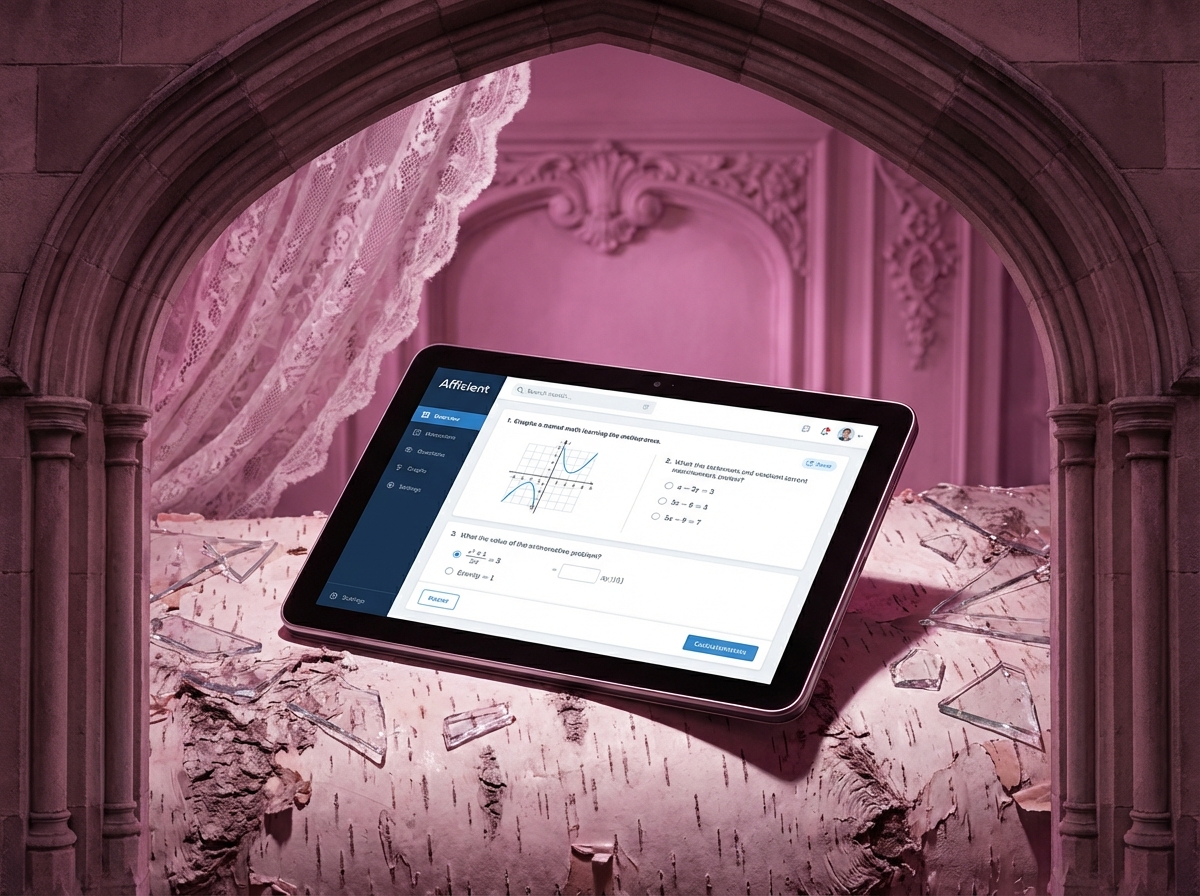
This is where Afficient’s approach fundamentally differs from traditional math instruction. Instead of rushing students through topics to keep pace with a predetermined curriculum, the system requires genuine mastery before advancement. Students must demonstrate 80-90% accuracy consistently—not just on one test, but across multiple problem types and contexts. There’s no faking it, no squeaking by with partial understanding.
This mastery threshold ensures that students build mathematical knowledge on solid ground. When they move to the next concept, they’re not carrying forward gaps and misconceptions that will sabotage their future learning. They’re building a coherent, interconnected understanding of mathematics where each new concept connects logically to what they already know.
Spaced Repetition: Making Knowledge Stick
But mastery at one moment isn’t enough. This is why Afficient incorporates spaced repetition into its learning system—the platform strategically brings back previously mastered topics at optimal intervals to prevent forgetting. Your child might master fractions in February, but the system will reintroduce fraction problems in March, April, and beyond, ensuring that knowledge moves from short-term memory into long-term retention.
This isn’t busywork or redundant practice. It’s based on decades of cognitive science research showing that spacing out practice over time is one of the most effective ways to build durable knowledge. When students revisit concepts they’ve already mastered, they’re not just remembering—they’re deepening their understanding and strengthening the neural pathways that make mathematical thinking automatic.
Want to see if your child truly understands or just memorizes? Get a free diagnostic assessment that reveals exactly where the gaps are.
Error Analysis: Understanding Why, Not Just Marking Wrong
Traditional math instruction often treats errors as simple mistakes to be corrected. But errors are actually windows into student thinking—they reveal specific misconceptions and gaps in understanding. Afficient’s AI-powered system analyzes not just whether answers are right or wrong, but why students make specific errors.
If your child consistently struggles with word problems involving percentages, the system doesn’t just assign more percentage practice. It investigates whether the issue is with understanding what percentages represent, with translating word problems into mathematical expressions, or with the underlying arithmetic. This diagnostic precision means practice time is spent addressing actual gaps rather than reinforcing what students already know.
Multiple Explanations: Finding the Approach That Clicks
Every student’s brain works differently. Some kids grasp concepts through visual representations, others through real-world examples, and still others through logical step-by-step reasoning. When one explanation doesn’t click, Afficient’s system automatically tries different approaches—offering alternative explanations, different problem types, and varied representations of the same concept.
This adaptive teaching mirrors what the best human tutors do instinctively: they don’t just repeat the same explanation louder when a student doesn’t understand. They find a different angle, a new metaphor, a fresh example that connects with that particular student’s way of thinking.
Discover where your child’s conceptual gaps are with a comprehensive free evaluation.
Speed vs Depth: You Don’t Have to Choose
Here’s what might surprise you: students who focus on deep understanding actually learn faster, not slower. Data from 7,831 Afficient students (based on research from 2018-2022) shows that over 90% advance a complete grade level in 2-5 months while achieving A/A+ grades. Students in grades 1-6 complete an entire grade level in a median time of 2 months.
How is this possible? Because when students truly understand concepts, they don’t waste time relearning material they’ve forgotten. They don’t struggle with each new topic because it builds logically on what they already know. They spend less time confused and frustrated, and more time experiencing the satisfaction of genuine mathematical competence.
Teaching Problem-Solving Skills and Application Strategies
Understanding concepts is crucial, but students also need explicit instruction in problem-solving strategies and application skills. Afficient’s curriculum doesn’t just present mathematical concepts—it systematically teaches students how to approach unfamiliar problems, how to identify which mathematical tools are relevant, and how to verify their solutions make sense.
This includes teaching students to ask themselves key questions: What is this problem actually asking? What information do I have? What mathematical concepts might be relevant here? Does my answer make sense in the context of the problem? These metacognitive skills—thinking about thinking—are what separate students who can only follow memorized procedures from those who can tackle novel challenges.
What Parents Can Do at Home
While a comprehensive learning system like Afficient provides the structure and personalization students need, parents can reinforce deep understanding at home:
Ask “why” questions constantly. When your child solves a problem, don’t just check if the answer is correct. Ask them to explain why they chose that approach, why the formula works, and whether there might be other ways to solve it.
Connect math to real life. Point out mathematical concepts in everyday situations—cooking (fractions and ratios), shopping (percentages and discounts), sports (statistics and probability). This helps children see math as a useful tool rather than an abstract school subject.
Encourage estimation and sense-making. Before your child calculates an exact answer, have them estimate what a reasonable answer might be. After they solve a problem, ask if their answer makes sense. This builds the habit of thinking critically about mathematical results.
Celebrate understanding, not just correct answers. When your child explains their reasoning clearly, even if they made a calculation error, acknowledge that understanding. This reinforces that mathematical thinking is about more than getting the right number.
The Long-Term Payoff: Building Independent Problem-Solvers
The ultimate goal isn’t just better math grades—though 90% of Afficient students achieving A/A+ grades is certainly a welcome outcome. The real goal is developing students who can think critically, solve complex problems, and apply their knowledge flexibly across different contexts. These are the skills that matter in college, in careers, and in life.
When students build genuine mathematical understanding rather than just memorizing procedures, they develop confidence in their ability to tackle unfamiliar challenges. They stop seeing math as a collection of arbitrary rules to memorize and start seeing it as a logical, coherent system they can reason through. This shift in mindset is transformative.
Moving Forward: From Memorization to Mastery
If your child has been stuck in the memorization trap—knowing steps but not when to use them—it’s not too late to change course. The key is finding an approach that prioritizes deep understanding, provides personalized support, and ensures genuine mastery before moving forward.
The difference between memorization and understanding isn’t just about better test scores. It’s about building mathematical confidence, developing problem-solving skills, and creating a foundation for lifelong learning. When students truly understand mathematics, they don’t just perform better—they actually enjoy the subject more because they experience the satisfaction of genuine competence rather than the anxiety of trying to remember disconnected procedures.
Take the free diagnostic test to see exactly what your child understands versus what they’ve just memorized. You’ll get a clear picture of where the gaps are and a personalized roadmap for building the deep understanding that leads to lasting mathematical success.
Your child’s struggle with applying memorized steps isn’t a permanent limitation—it’s a signal that they need a different approach. With the right support, every student can move from surface-level memorization to deep, flexible understanding that serves them not just in their next math test, but throughout their academic journey and beyond.