
Geometry represents a unique challenge in mathematics education. Unlike algebra or arithmetic, it demands a different kind of thinking—spatial reasoning, visual interpretation, and logical proof construction. If your child is failing geometry, you’re not alone. This subject creates a bottleneck for countless students who may excel in other math areas but struggle when shapes, angles, and proofs enter the picture.
Understanding Why Geometry is Different
Geometry requires a fundamental shift in mathematical thinking. While algebra focuses on manipulating symbols and solving equations, geometry asks students to visualize three-dimensional objects, understand spatial relationships, and construct logical arguments. This cognitive leap explains why a student who earned A’s in algebra might suddenly face failing grades in geometry.
The challenge intensifies because geometry integrates multiple skill sets simultaneously. Students must read and interpret diagrams, apply abstract theorems to concrete problems, write formal proofs using logical reasoning, and translate between visual and algebraic representations. When any of these skills is underdeveloped, the entire geometric understanding can crumble.
Research shows that spatial reasoning abilities vary significantly among students. Some naturally visualize rotations and transformations, while others struggle to see beyond the two-dimensional page. This isn’t a reflection of intelligence—it’s simply a different cognitive strength that requires targeted development.
Identifying the Root Causes of Geometry Failure
Before addressing geometry struggles, parents must identify the specific breakdown points. Failing grades rarely stem from a single cause. Instead, multiple factors typically converge to create academic difficulty.
Foundation gaps often hide beneath surface-level geometry problems. A student struggling with triangle similarity might actually lack solid fraction skills. Difficulty with coordinate geometry could trace back to weak algebraic manipulation. Problems with area and volume calculations might reveal measurement concept gaps. These prerequisite skill deficiencies create cascading failures as geometry concepts build upon one another.
Visual-spatial processing challenges represent another common obstacle. Some students cannot mentally rotate shapes, struggle to recognize congruent figures in different orientations, or fail to connect two-dimensional diagrams with three-dimensional objects. These difficulties aren’t laziness—they’re genuine cognitive challenges requiring specific intervention strategies.
Proof-writing presents its own unique hurdles. Constructing logical arguments demands skills many students haven’t developed: organizing thoughts sequentially, justifying each step with appropriate theorems, and recognizing when sufficient evidence has been provided. The abstract nature of proofs feels disconnected from the concrete math students previously encountered.
Why Traditional Tutoring Often Falls Short
Generic math tutoring frequently misses the mark with geometry struggles. A tutor who simply re-explains the same concepts using the same methods won’t help a student whose brain processes spatial information differently. The student needs alternative approaches, multiple representations, and targeted skill-building—not just more of what didn’t work in class.
Traditional tutoring also tends to focus on immediate homework help rather than systematic gap-filling. A tutor might help a student complete tonight’s assignment on parallelograms, but if that student lacks understanding of angle relationships or hasn’t mastered basic algebraic solving, the underlying problems persist. Next week brings new geometry topics, and the student falls further behind.
Time constraints compound these issues. Most tutoring sessions last one or two hours weekly—insufficient for addressing deep conceptual gaps while keeping pace with ongoing classwork. Students need consistent, daily practice with immediate feedback to build geometric intuition and spatial reasoning skills.
Effective Strategies for Geometry Recovery
Successful geometry intervention requires a multi-faceted approach addressing both conceptual understanding and skill gaps. The most effective strategies combine visual learning, systematic practice, and targeted remediation.
Multiple representation methods help students build geometric understanding from different angles. Present each concept through diagrams, algebraic equations, coordinate graphs, and real-world applications. When a student sees that the Pythagorean theorem appears in distance formulas, right triangle problems, and coordinate geometry, the connections strengthen retention and understanding.
Systematic skill assessment identifies exactly which prerequisite concepts need reinforcement. Rather than assuming a failing student needs to relearn all of geometry, pinpoint the specific gaps. Does the student struggle with angle relationships? Algebraic manipulation? Measurement conversions? Fraction operations? Targeted practice on these foundational skills often produces rapid improvement in geometry performance.
Step-by-step proof guidance breaks down the intimidating process of logical reasoning. Start with fill-in-the-blank proofs where students supply missing reasons. Progress to proofs with given statements that students must order correctly. Eventually, students construct complete proofs independently. This scaffolded approach builds confidence while developing logical thinking skills.
Discover your child’s specific geometry gaps with a comprehensive diagnostic assessment that identifies both surface-level struggles and hidden prerequisite weaknesses.
How AI-Powered Learning Addresses Geometry’s Unique Challenges
Modern adaptive learning technology offers solutions specifically designed for geometry’s distinctive demands. Afficient Academy’s WASC-accredited platform uses patented AI-driven adaptive learning algorithms to analyze student work, identifying not just wrong answers but the underlying skill gaps causing those errors.
The system’s approach to geometry differs fundamentally from traditional tutoring. When a student struggles with triangle congruence proofs, Afficient’s AI doesn’t simply re-explain congruence postulates. Instead, it assesses whether the student understands angle relationships, can identify corresponding parts, possesses adequate algebraic skills, and grasps logical reasoning structure. The platform then assigns targeted practice on whichever skills need strengthening.
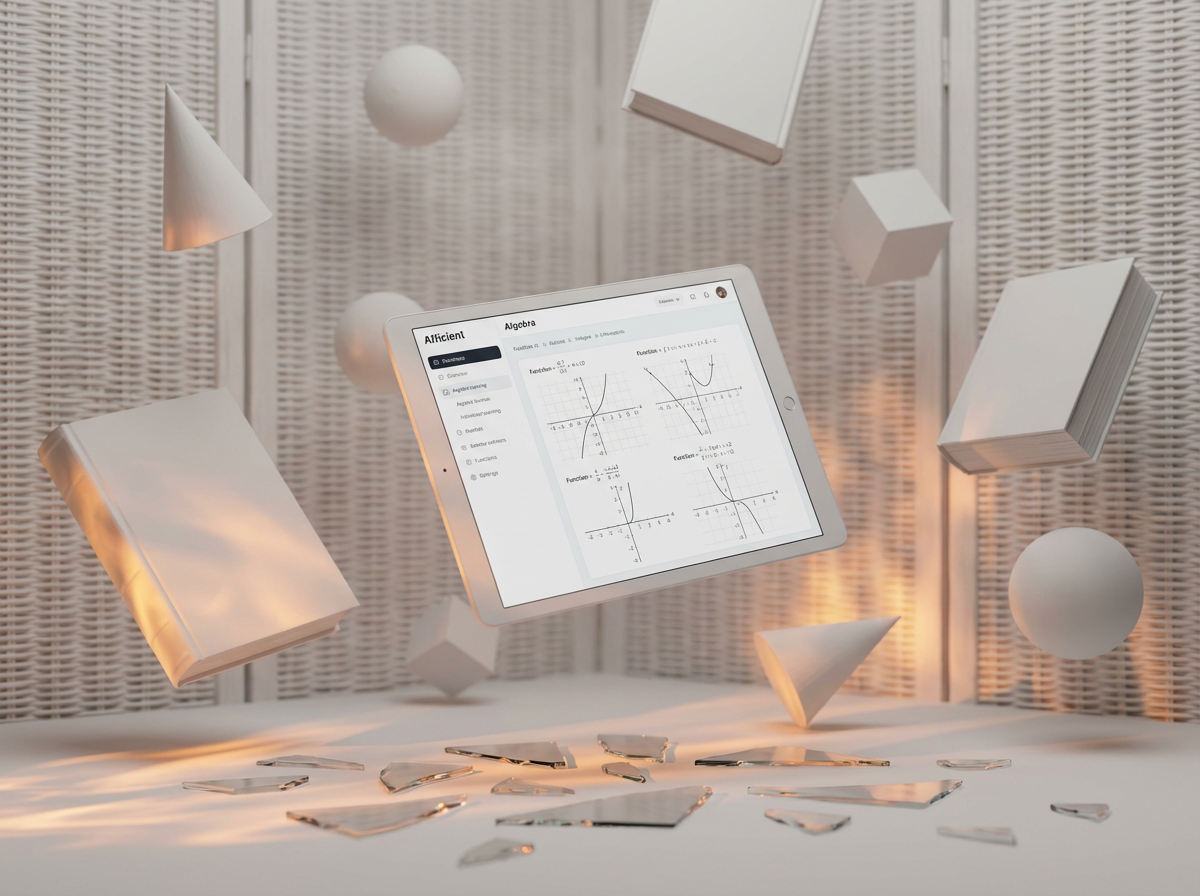
Visual aids and multiple solution methods address different learning styles. Afficient presents geometric concepts through interactive diagrams, coordinate representations, and algebraic approaches. Students who struggle with abstract proofs might grasp concepts through coordinate geometry. Those confused by algebraic methods might understand through pure geometric reasoning. The platform adapts to each student’s strengths.
Error pattern analysis reveals why students make mistakes, not just that they made them. This distinction proves crucial for geometry, where similar wrong answers can stem from completely different misunderstandings. A student might calculate triangle area incorrectly due to fraction errors, formula confusion, or measurement unit problems. Afficient identifies the actual cause and addresses it directly.
Real results demonstrate this approach’s effectiveness. Over 90% of Afficient students improve by one grade level and achieve A or A+ grades within 2-5 months, even in challenging geometry courses. Students master complex topics like proofs, transformations, and three-dimensional geometry by building solid foundations and developing genuine spatial reasoning skills.
See how Afficient makes geometry click through personalized learning paths that adapt to your child’s specific needs and learning style.
Building Spatial Reasoning Skills
Spatial reasoning development requires consistent practice with varied activities. Parents can support geometry learning through everyday experiences that build visual-spatial thinking.
Encourage hands-on manipulation of three-dimensional objects. Building with blocks, solving tangram puzzles, or constructing models helps students internalize spatial relationships. These tactile experiences create mental frameworks for understanding geometric transformations and three-dimensional visualization.
Practice mental rotation exercises. Ask your child to imagine how a shape would look from different angles or after specific transformations. Start with simple shapes and progress to more complex figures. This mental practice strengthens the visualization skills essential for geometry success.
Connect geometry to real-world applications. Point out geometric principles in architecture, art, nature, and everyday objects. When students see geometry as relevant rather than abstract, motivation and understanding both increase. Discuss why bridges use triangular supports, how perspective creates depth in drawings, or why hexagons appear in honeycombs.
Creating an Effective Home Study Environment
Consistent daily practice proves more effective than marathon study sessions. Geometry skills develop through regular engagement, not cramming before tests.
Establish a dedicated study routine with 30-45 minutes of focused geometry practice daily. This consistent schedule builds skills progressively while preventing the overwhelming backlog that leads to failure. Short, regular sessions also improve retention compared to longer, sporadic study periods.
Ensure immediate feedback on practice problems. Students who must wait days to learn whether their work was correct miss crucial learning opportunities. Immediate feedback allows students to correct misconceptions before they become ingrained habits. Afficient’s platform provides instant feedback with explanations, helping students understand errors immediately.
Monitor progress through specific skill mastery rather than just grades. A student might earn a C on a test covering multiple topics while actually mastering some concepts and completely missing others. Detailed progress tracking reveals exactly which geometric skills need more work, allowing targeted practice on weak areas.
When to Seek Additional Support
Recognizing when professional intervention becomes necessary prevents prolonged struggle. While parental support helps, some situations require specialized assistance.
If your child shows consistent geometry failure despite regular study, underlying issues may need professional assessment. Learning disabilities affecting spatial reasoning, visual processing disorders, or math anxiety might require specialized intervention beyond standard tutoring.
Significant prerequisite gaps spanning multiple grade levels often need systematic remediation. A high school geometry student with elementary-level fraction weaknesses needs comprehensive skill-building that addresses years of accumulated gaps. Adaptive learning platforms excel at this type of comprehensive remediation.
Time pressure from advancing coursework sometimes necessitates intensive support. When a student must pass geometry to graduate or meet college admission requirements, waiting for gradual improvement isn’t feasible. Targeted, intensive intervention can produce rapid results when properly implemented.
The Path Forward: From Failing to Mastering Geometry
Geometry failure doesn’t predict future math ability. With proper support, targeted practice, and effective learning strategies, students can transform from failing geometry to mastering it—often within a single semester.
The key lies in addressing actual causes rather than symptoms. Surface-level tutoring that helps with homework without fixing underlying gaps produces temporary grade improvements that collapse when new topics arrive. Comprehensive approaches that identify and remediate prerequisite skills, build spatial reasoning, and develop proof-writing abilities create lasting geometry competence.
Success stories abound of students who struggled initially but achieved geometry mastery through systematic intervention. Parents report dramatic improvements when their children receive properly targeted support that addresses individual learning needs rather than generic instruction.
Your child’s geometry struggle represents a solvable problem, not a permanent limitation. The spatial reasoning and logical thinking skills developed through geometry mastery benefit students far beyond mathematics, enhancing problem-solving abilities across all academic areas and future careers.
Take the free diagnostic test to identify and address your child’s specific geometry challenges. With the right support and systematic approach, geometry success is achievable—transforming failure into confidence and competence.