I hear you—it’s incredibly frustrating when your child can recite formulas perfectly but completely freezes when faced with a word problem. You watch them ace the practice worksheet, only to bomb the test two weeks later. They’re putting in the hours, doing the homework, but somehow the math just isn’t sticking. You’re not alone in this struggle, and more importantly, there’s a real reason why this happens.
Why Memorization Feels Easier But Always Fails
Here’s what’s really going on: your child has learned to play a game called “pattern matching” instead of actually understanding math. They see “area of rectangle” and immediately think “length times width”—but they have no idea why that formula works or what it actually means. It’s like learning to pronounce French words without knowing what they mean. Sure, you can sound fluent, but the moment someone asks you a question, you’re lost.
This is what cognitive scientists call surface learning versus deep learning. Surface learning is fast and feels productive—your kid can memorize 20 formulas in an hour. But deep learning, where they actually understand the concepts, takes more initial effort. The catch? Deep learning is what makes math stick, while memorized formulas start fading from memory the moment the test is over.
Research shows that students who rely on memorization face what’s called the “forgetting curve”—they lose about 50-80% of memorized information within days if they don’t truly understand it. That’s why your child aces the unit test but fails the cumulative exam. The formulas were never really learned; they were just temporarily stored.
The Real Problem: Moving Too Fast Without Building Understanding
Traditional math education has a fundamental flaw: it rushes students forward whether they’re ready or not. Your child gets 60% on a test, and the class moves on to the next unit anyway. Those gaps in understanding don’t disappear—they compound. By the time they hit algebra, they’re trying to build on a foundation full of holes.
Think about it like learning to read. You wouldn’t move a child from basic phonics to chapter books if they couldn’t decode simple words, right? But that’s exactly what happens in math. Students who don’t truly grasp fractions are pushed into algebra, where fractions are everywhere. Students who memorized the Pythagorean theorem without understanding it struggle with trigonometry.
The frustration you’re seeing isn’t because your child “isn’t a math person.” It’s because they’ve been taught to memorize instead of understand, and they’ve been moved forward before they were ready.
What Research Says Actually Works: Mastery-Based Learning
Here’s the good news: there’s a proven approach that helps middle schoolers not just learn math, but actually understand and remember it. It’s called mastery-based learning, and it’s built on a simple principle: students don’t move forward until they truly get it.
Mastery-based learning means no faking it. Instead of moving on after getting 60% or 70% on a test, students work with material until they hit 80-90% accuracy consistently. This isn’t about being a perfectionist—it’s about ensuring the foundation is solid before building on it.
When students achieve true mastery, something remarkable happens: they learn faster overall. It seems counterintuitive—wouldn’t spending more time on each topic slow them down? Actually, no. Students who deeply understand concepts don’t waste time re-learning material they’ve forgotten. They don’t struggle with new topics because they have the prerequisite knowledge locked in. Research shows that mastery-based students can learn 2-5x faster than their peers in traditional programs because they’re not constantly backtracking.
The Power of Spaced Repetition: Making Math Stick
Even when students understand a concept, they’ll forget it without reinforcement. This is where spaced repetition comes in—one of the most powerful learning techniques backed by cognitive science.
Spaced repetition means coming back to topics at strategic intervals so they stick in long-term memory. Instead of cramming before a test and forgetting everything afterward, students review material just as they’re about to forget it. This strengthens neural pathways and moves knowledge from short-term to long-term memory.
Here’s what this looks like in practice: Your child learns about solving equations in October. Instead of never seeing that material again until the final exam, they get practice problems on equations mixed into their November and December work. Each time they successfully solve these problems, the knowledge gets reinforced. By the time the cumulative test arrives, they haven’t forgotten—the concepts are part of their permanent mathematical toolkit.
Want to see if your child truly understands or just memorizes? Get a free diagnostic assessment that reveals exactly where the gaps are.
Understanding Why, Not Just How
One of the biggest differences between students who excel at math and those who struggle is whether they understand the “why” behind procedures. Memorizing that you “flip and multiply” for dividing fractions is useless if you don’t understand what division of fractions actually means.
When students understand why mathematical procedures work, several things happen:
They can adapt to new situations. If they truly understand what division means, they can figure out how to divide fractions even if they forget the specific procedure. They’re not helpless without their formula sheet.
They can catch their own mistakes. Students who understand concepts can look at an answer and think, “Wait, that doesn’t make sense.” Students who just memorize procedures have no way to check if their answer is reasonable.
They can solve unfamiliar problems. Word problems and application questions require understanding, not just memorization. When students grasp the underlying concepts, they can tackle problems they’ve never seen before.
Multiple Pathways to the Same Answer
Different students understand concepts in different ways. Some are visual learners who need to see geometric representations. Others are more algebraic and prefer symbolic manipulation. Some need real-world contexts to make sense of abstract ideas.
Effective math learning provides multiple explanations and approaches to the same concept. If one way doesn’t click, there’s another approach to try. This is especially important for middle schoolers, who are at different developmental stages and have different cognitive strengths.
For example, understanding slope can be taught through: – Visual: the steepness of a line on a graph – Algebraic: the ratio of rise over run – Real-world: the grade of a hill or ramp – Kinesthetic: physically walking up stairs and measuring
When students see concepts from multiple angles, understanding deepens. They’re not just memorizing one procedure—they’re building a rich mental model of the concept.
How Afficient Makes This Approach Work
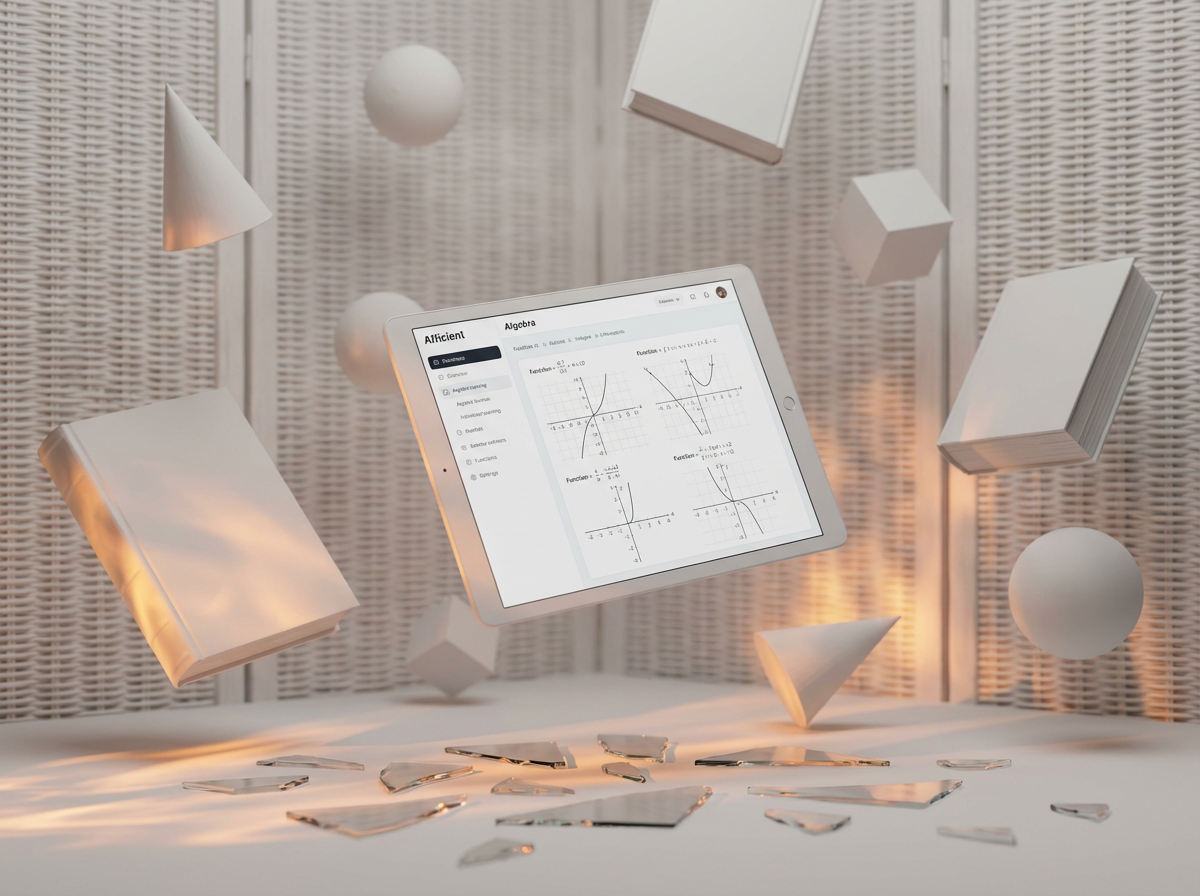
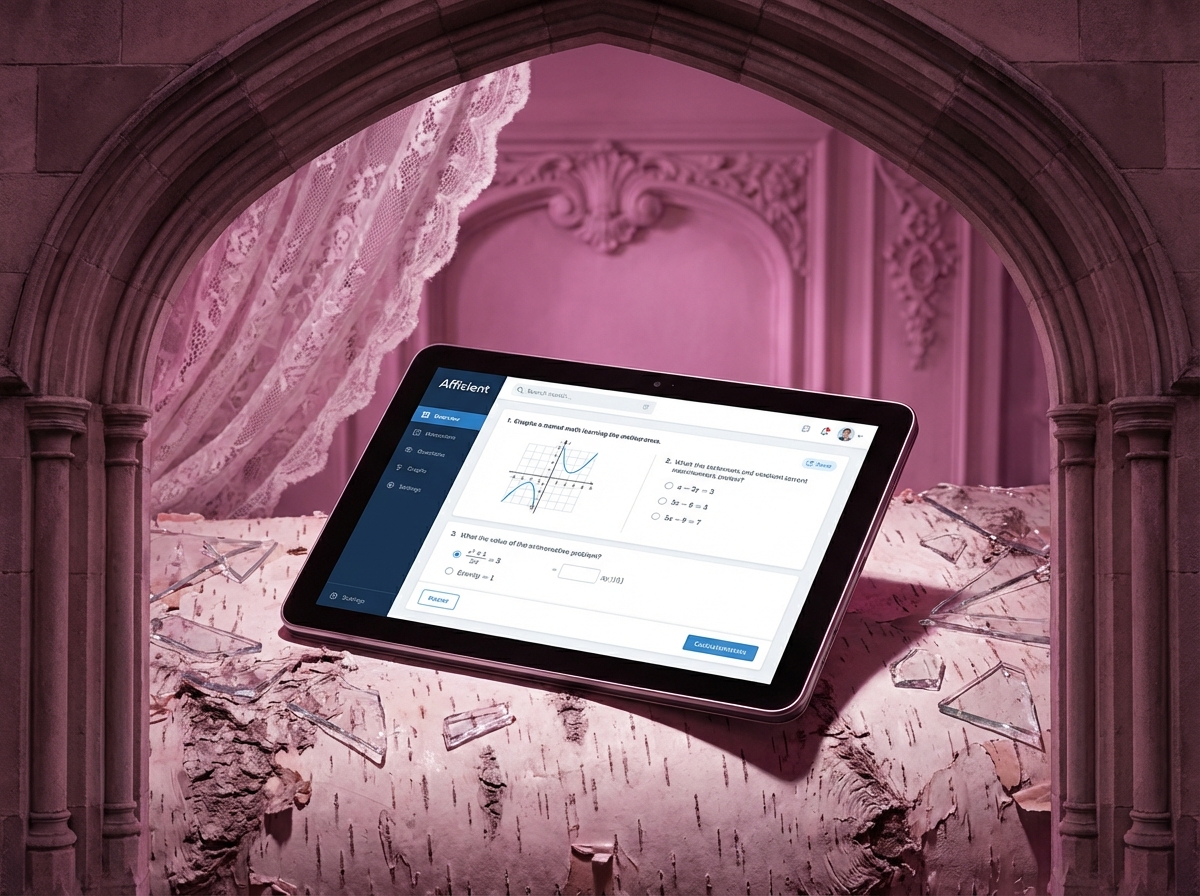
Here’s what makes Afficient different from traditional math programs and other online platforms. The system is built around the research-backed principles that actually help middle schoolers understand and remember math.
Mastery thresholds that mean something: Students can’t advance to new topics until they hit 80-90% accuracy on current material. No faking it, no moving forward with gaps. This ensures every student has a solid foundation before building on it.
Intelligent spaced repetition: The platform uses spaced repetition to help students retain what they’ve learned over time.
Error analysis that identifies why students are confused: The platform provides feedback to help students understand their mistakes and improve their understanding.
Multiple explanations for every concept: If one approach doesn’t click, the system tries another. Visual learners get diagrams and graphs. Algebraic thinkers get symbolic representations. Students who need context get real-world applications. Everyone gets the explanation that works for their learning style.
Discover where your child’s conceptual gaps are with a comprehensive free evaluation.
Real results that prove deep understanding: Afficient students show significant improvement in their math understanding and performance. But more importantly, they’re not just memorizing—they’re truly understanding. They can explain concepts, solve unfamiliar problems, and apply math to new situations.
You Don’t Have to Choose Between Speed and Understanding
One concern parents often have is: “Won’t focusing on deep understanding slow my child down?” It’s a reasonable worry, especially if your child is already behind or struggling to keep up with their class.
Here’s the reality: Research shows that mastery-based students can learn more efficiently than their peers in traditional programs because they’re not constantly backtracking. How is this possible if they’re spending more time on each topic?
Because they truly understand, they don’t waste time re-learning material they’ve forgotten. They don’t struggle with new topics because they have the prerequisite knowledge locked in. They don’t need extensive test prep because the knowledge is already solid. The time invested in deep understanding pays massive dividends in learning speed.
Think of it like building a house. You can rush through the foundation to get to the fun parts faster, but you’ll spend years dealing with cracks and structural problems. Or you can take the time to build a solid foundation, and then construction goes smoothly and quickly. Deep understanding is that solid foundation.
Practical Tips You Can Use at Home
While a comprehensive learning platform provides the structure and consistency students need, there are things you can do at home to reinforce deep understanding:
Ask “why” and “how do you know?” When your child solves a problem, don’t just check if the answer is right. Ask them to explain their reasoning. If they can’t explain it, they don’t truly understand it.
Connect math to real life. Point out math in everyday situations—calculating tips, measuring for recipes, understanding sports statistics. When students see math as useful rather than abstract, it becomes more meaningful.
Encourage multiple solution methods. If your child solves a problem one way, ask if they can think of another approach. This builds flexibility and deeper understanding.
Review old material regularly. Don’t let your child forget topics after the test. Bring back old concepts periodically to keep them fresh.
Focus on understanding, not speed. Resist the urge to push your child to work faster. Speed comes naturally once understanding is solid. Rushing leads to surface learning and memorization.
The Bottom Line: Understanding Changes Everything
The difference between students who excel at math and those who struggle often isn’t natural ability—it’s whether they’ve been taught to understand or just memorize. When middle schoolers truly grasp mathematical concepts, everything changes. They’re not anxious about tests because they actually know the material. They don’t freeze on word problems because they understand what the math means. They don’t forget everything after the exam because the knowledge is deeply embedded.
You don’t have to accept that your child “just isn’t good at math.” With the right approach—one that prioritizes mastery, uses spaced repetition, provides multiple explanations, and ensures deep understanding—any student can succeed.
Take the free diagnostic test to see exactly what your child understands versus what they’ve just memorized. You’ll get a clear picture of where the gaps are and a personalized plan to fill them. Because every child deserves to truly understand math, not just survive it.