
Every parent of a gifted child knows the frustration: your child breezes through math class in minutes, finishes worksheets while others are still reading the instructions, and comes home complaining that school is “too easy” and “boring.” This isn’t a problem of ability—it’s a problem of challenge. When high-achieving students aren’t intellectually stimulated, they don’t just coast; they disengage, develop poor work habits, and lose the very curiosity that made them exceptional in the first place.
The challenge facing parents of advanced learners is fundamentally different from typical math education concerns. Your child doesn’t need more practice with grade-level content—they need unlimited ceiling, genuine challenge, and the freedom to advance as fast as their abilities allow. Traditional gifted programs often fall short, capping progress at predetermined levels or requiring rigid schedules that don’t match your child’s learning pace.
This comprehensive guide explores proven strategies to keep high-achieving children deeply engaged in mathematics, with a focus on adaptive, self-paced approaches that remove artificial limits on growth. Whether your elementary student is ready for algebra or your middle schooler is tackling calculus, the right approach can transform boredom into boundless intellectual excitement.
Understanding the Gifted Learner’s Unique Challenge
High-achieving students face a paradox in traditional education: the very traits that make them exceptional—rapid comprehension, pattern recognition, and abstract thinking—become liabilities in one-size-fits-all classrooms. When a child can master in one week what the curriculum allocates three months to teach, the remaining time becomes intellectual dead space.
Research consistently shows that unchallenged gifted students experience significant negative outcomes. Boredom leads to disengagement, which develops into learned helplessness and poor work habits. Students who never encounter genuine difficulty in their formative years often struggle when they finally meet appropriate challenge in higher education, lacking the resilience and study skills their peers developed through productive struggle.
The solution isn’t simply “harder problems”—it’s removing the ceiling entirely. Advanced learners need environments where there’s no predetermined endpoint, where mastery of one concept immediately opens doors to the next, and where the pace of learning matches the pace of understanding. This is where traditional gifted programs, despite good intentions, often fail.
What Advanced Learners Actually Need
Unlimited progression without artificial grade-level caps stands as the most critical requirement for gifted math students. An eight-year-old capable of understanding algebraic concepts shouldn’t be held back by curriculum designers who decided algebra belongs in eighth grade. Similarly, a sixth grader ready for calculus shouldn’t wait six years because of administrative convenience.
True self-pacing means more than “work ahead in the textbook.” It means adaptive difficulty that responds in real-time to student performance, creating custom challenges that maintain the sweet spot between frustration and boredom. When a student demonstrates mastery, the system should immediately present more complex material—not next week, not next semester, but immediately.
Deep, challenging content matters more than breadth for advanced learners. Rather than racing through surface-level problems, gifted students thrive when exploring mathematical concepts in depth, making connections across domains, and tackling open-ended problems with multiple solution paths. This depth of engagement prevents the “mile wide, inch deep” problem that plagues accelerated programs focused solely on speed.
Flexibility in scheduling and location removes another common barrier. Gifted students often have multiple interests and commitments—music, sports, academic competitions. Requiring attendance at fixed class times creates unnecessary conflicts and stress. The ideal learning environment adapts to the student’s schedule, not vice versa.
How Afficient Removes the Ceiling for Advanced Learners
Discover your child’s true potential__ with our advanced diagnostic assessment__ that reveals exactly where your child stands and how far they can go.
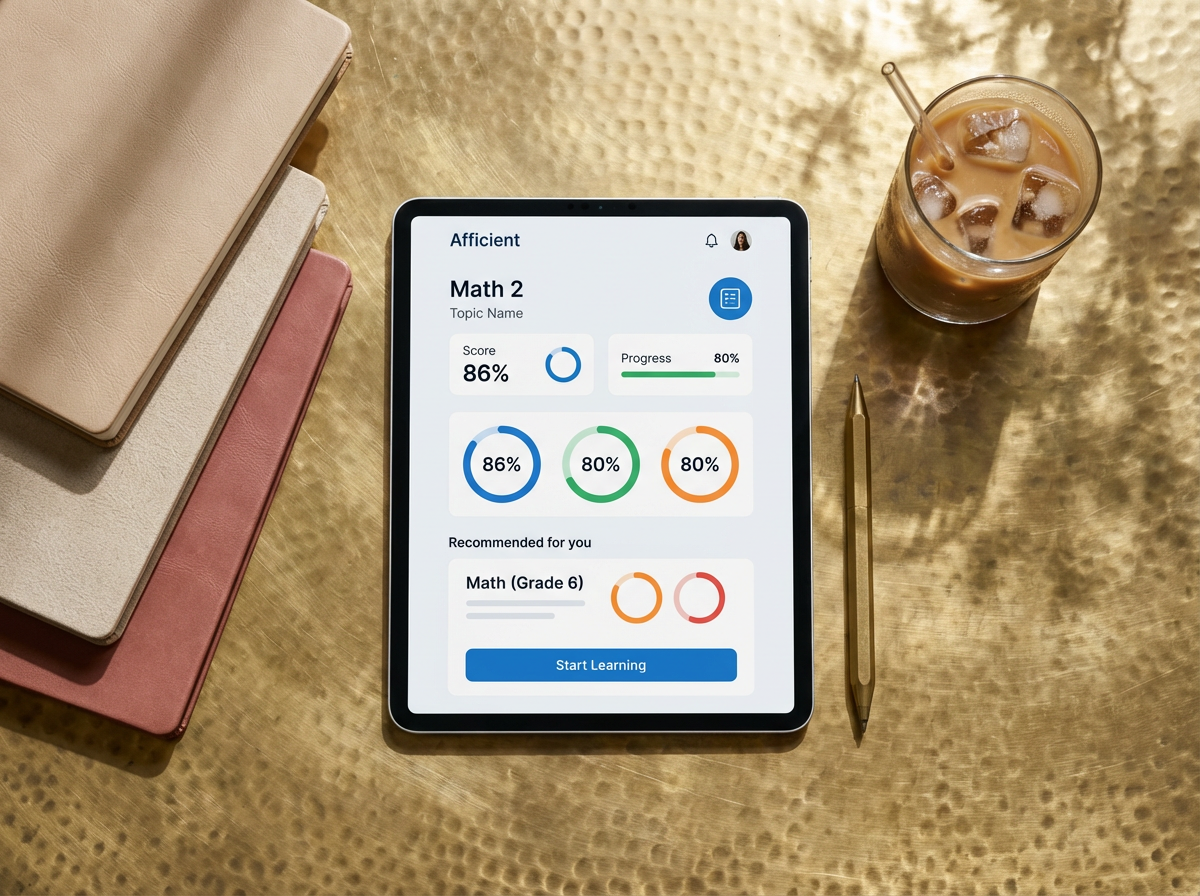
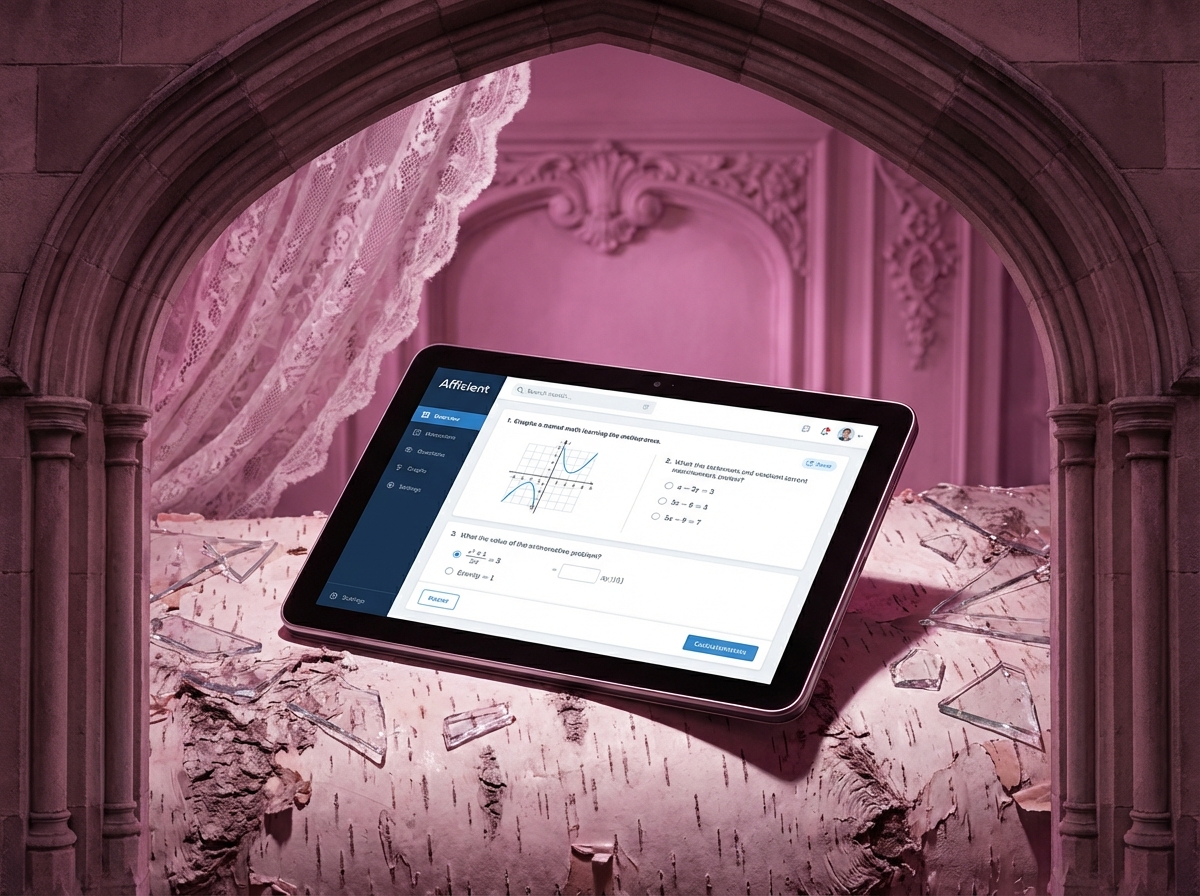
Afficient’s AI-powered platform fundamentally reimagines math education for high-achieving students by eliminating the constraints that limit traditional programs. The system uses sophisticated adaptive algorithms to create truly personalized learning paths with no upper boundary. An elementary student demonstrating readiness for high school mathematics can access that content immediately—the AI doesn’t care about grade levels, only about mastery and readiness.
The platform’s hyper-personalization goes beyond simple difficulty adjustment. Every problem, explanation, and practice set adapts to the individual student’s learning style, pace, and current understanding. If a student masters quadratic equations in two days instead of two weeks, the system recognizes this and moves forward. If they need deeper exploration of a particular concept, the AI generates custom problems targeting that specific gap.
The platform’s adaptive approach enables students to work at their true capability level, advancing through content based on mastery rather than age or grade level. The accelerated learning rate isn’t a marketing claim—it’s the natural result of removing artificial barriers and letting students learn at their true capability level.
Engagement tracking ensures challenge without frustration. The AI monitors not just correctness but also time spent, problem-solving approaches, and patterns of struggle. This allows the system to maintain optimal difficulty—hard enough to require genuine thought, but not so hard as to create discouragement. For gifted students who’ve spent years being bored, this consistent intellectual stimulation proves transformative.
The flexibility advantage cannot be overstated. Students access Afficient anytime, anywhere, on any device. No commuting to physical locations, no missing classes due to family travel, no conflicts with other activities. Learning happens when the student is ready and motivated, not according to an arbitrary schedule.
Comparing Approaches: Traditional Gifted Programs vs. Adaptive Learning
Traditional gifted programs, despite their reputation, impose significant limitations that frustrate both students and parents. Programs like Art of Problem Solving (AOPS) offer excellent curriculum but require attendance at scheduled classes—often inconvenient times that conflict with other commitments. The curriculum, while advanced, still follows a predetermined path that may not match an individual student’s readiness.
Beast Academy provides engaging content but caps at fifth-grade level, leaving advanced elementary students without a clear path forward. Russian School of Mathematics (RSM) requires in-person attendance at specific locations and times, creating logistical challenges for busy families. Johns Hopkins Center for Talented Youth (CTY) offers prestigious programs but at premium prices with limited availability and rigid summer schedules.
See how far your advanced learner can go__ with our free evaluation__ that maps their unique learning trajectory.
Afficient addresses each of these limitations systematically. No curriculum caps mean students advance as far as ability allows. No fixed schedules mean learning fits into life rather than dominating it. No physical location requirements mean access from anywhere. The cost-effectiveness compared to premium gifted programs makes unlimited advancement accessible to more families.
The competitive advantage becomes clear when examining specific scenarios. A student ready to move from geometry to trigonometry doesn’t wait for the next semester to start—they transition immediately upon demonstrating mastery. A family traveling for two weeks doesn’t fall behind—the student continues learning from hotels, relatives’ homes, or anywhere with internet access. A child with multiple interests doesn’t choose between math advancement and other pursuits—flexible scheduling accommodates everything.
Addressing Common Concerns from Parents of Gifted Children
“Will it really be challenging enough for my child?” This question reflects justified skepticism born from years of programs promising challenge but delivering more of the same easy work. The answer lies in understanding how AI-driven adaptive difficulty differs from traditional approaches. Rather than selecting from a predetermined bank of “hard problems,” the system generates custom challenges based on the student’s demonstrated capabilities. As the student grows stronger, the challenges grow proportionally—there’s no ceiling to hit.
“Can they truly advance without limits, or will they eventually hit a wall?” Traditional programs hit walls because they’re designed around grade-level standards and predetermined curricula. Afficient’s architecture contains no such walls. The content library spans from basic arithmetic through advanced calculus and beyond. Students progress based on mastery, not age or grade. The only limit is the student’s current readiness for new concepts—and as they master each level, the next opens immediately.
“How do you prevent boredom while ensuring they’re actually learning?” This balance represents the core challenge in gifted education. The AI maintains engagement through several mechanisms: optimal difficulty calibration that requires genuine thought without causing frustration, varied problem types that prevent monotony, immediate progression upon mastery that eliminates waiting, and real-time feedback that creates a responsive learning dialogue. Students report feeling challenged and engaged because they’re working at their actual level rather than an age-based approximation.
“What about social interaction and collaborative learning?” While Afficient focuses on individualized advancement, this doesn’t mean isolation. Students often work alongside siblings or friends, discussing problems and sharing insights. Parents report that removing the frustration of being held back actually improves their children’s attitude toward collaborative learning in other settings. When students feel intellectually satisfied in their core learning, they bring more positive energy to group activities.
Practical Guidance for Parents of Advanced Learners
Start with accurate assessment of current capabilities, not grade level. Many gifted students have uneven skill development—perhaps exceptional in algebraic thinking but less developed in geometric visualization. A comprehensive diagnostic reveals these patterns, allowing for targeted advancement rather than blanket acceleration. Take the free diagnostic test__ to unlock unlimited learning potential for your gifted child__ and receive a detailed capability map.
Embrace self-paced learning as a philosophy, not just a feature. This means trusting your child to work at their natural pace, even when that pace seems unusually fast or when they want to spend extra time exploring a particularly interesting concept. The goal isn’t racing through content—it’s deep mastery and genuine understanding. Some students will accelerate rapidly through computational skills but slow down for abstract concepts, and that’s perfectly appropriate.
Monitor engagement and challenge level regularly. Ask your child specific questions: “Did you have to think hard about any problems today?” “Were you bored at any point?” “Did you learn something that surprised you?” These conversations reveal whether the difficulty calibration is working. If your child consistently reports everything being too easy, the system should be advancing faster. If they’re frequently frustrated, the pace may need adjustment.
Celebrate intellectual growth, not just speed. Gifted children often internalize the message that their worth comes from being “the smart one” or “the fast one.” Redirect praise toward effort, problem-solving strategies, and persistence through difficult concepts. When your child masters calculus at age twelve, celebrate the understanding they’ve gained, not just the age at which they achieved it.
Maintain balance with other interests and activities. The flexibility of adaptive online learning makes this possible in ways traditional gifted programs don’t. Your child can pursue music, sports, art, and social activities without sacrificing mathematical advancement. In fact, research shows that well-rounded gifted students often perform better academically than those who focus exclusively on their area of strength.
Connect with other parents of advanced learners. The challenges of raising a gifted child can feel isolating, especially when other parents don’t understand why you’re concerned about your child being “too smart.” Online communities and local gifted education groups provide valuable support, perspective, and practical advice from those navigating similar journeys.
The Path Forward: Excellence Without Limits
The future of gifted math education lies in removing artificial constraints and trusting students to rise to their capabilities. Traditional models built around grade levels, fixed curricula, and batch processing of students made sense in an era of limited resources and technology. Today, adaptive AI makes truly individualized, unlimited learning not just possible but practical and affordable.
For parents of high-achieving children, the choice becomes clear: continue fighting against systems designed for average students, or embrace platforms built specifically for exceptional learners. The difference isn’t just in outcomes—though students using adaptive platforms consistently demonstrate accelerated advancement—but in daily experience. Instead of coming home frustrated and bored, students engage with material that genuinely challenges them. Instead of waiting for classmates to catch up, they progress immediately upon mastery.
The investment in your child’s mathematical future doesn’t require premium prices or prestigious program names. It requires the right approach: unlimited ceiling, true self-pacing, adaptive difficulty, and flexible access. These elements combine to create an environment where gifted students don’t just learn faster—they develop deeper understanding, stronger problem-solving skills, and genuine love for mathematical thinking.
Your high-achieving child deserves more than being the fastest student in a slow class. They deserve unlimited potential, immediate challenge, and the freedom to explore mathematics as far as their curiosity and capability can take them. The question isn’t whether they can handle advanced content—you already know they can. The question is whether their learning environment will let them.
Discover your child’s true potential with Afficient’s comprehensive diagnostic assessment. See exactly where your advanced learner stands, identify their unique strengths and growth areas, and unlock a personalized learning path with no upper limit. The assessment is free, the insights are invaluable, and the potential is unlimited.