
The Visual Geometry Toolkit: How Middle Schoolers Learn Best Through Hands-On Discovery
Geometry becomes easier for middle schoolers when learning shifts from abstract textbook definitions to concrete, visual experiences. The key is using manipulatives like pattern blocks and geoboards, connecting shapes to real-world objects students already know, and building spatial reasoning through interactive activities rather than memorization. Research shows that students who engage with geometry through hands-on tools and visual representations improve problem-solving ability by 25% and retain concepts significantly longer. Platforms like Afficient Academy use adaptive AI to identify exactly which geometric concepts—from angle classification to shape properties—need reinforcement, then provide targeted visual practice that mirrors the manipulative-based learning proven effective in classrooms.
Why Middle Schoolers Struggle With Traditional Geometry Instruction
The typical middle school geometry curriculum introduces abstract concepts—parallel lines, congruent triangles, three-dimensional nets—before students have developed sufficient spatial reasoning skills. Most 11-13 year olds are still transitioning from concrete operational thinking to formal reasoning, according to the van Hiele levels of geometric understanding. When textbooks jump straight to formal definitions and proofs, students lack the mental imagery needed to make sense of properties like "opposite angles are equal" or "the sum of interior angles in a triangle equals 180 degrees."
Traditional worksheets compound the problem by presenting static diagrams that students cannot manipulate or explore. A student looking at a printed triangle cannot rotate it, fold it, or compare it side-by-side with other shapes. This passive learning style fails to activate the kinesthetic and visual processing pathways that make geometry intuitive. Without opportunities to physically interact with shapes, middle schoolers memorize formulas without understanding the underlying spatial relationships.
Hands-On Manipulatives: Building Geometric Intuition Through Touch
Tactile learning tools transform abstract geometry into tangible experiences. Pattern blocks, geometric solids, geoboards, and folding paper allow students to discover properties through exploration rather than memorization.
Pattern blocks and tangrams help students understand shape composition and decomposition. When a student uses two triangles to create a parallelogram, they internalize the relationship between these shapes in a way that no diagram can replicate. Middle schoolers can explore symmetry by creating mirror-image designs, investigate tessellations by fitting shapes together without gaps, and compare area by counting how many small triangles equal one hexagon.
Geoboards with rubber bands make angle measurement and perimeter calculation interactive. Students stretch bands to form triangles, quadrilaterals, and irregular polygons, then physically measure angles with protractors and count unit squares to find area. This hands-on approach reveals why a rectangle with sides 3×4 has the same area as a 2×6 rectangle—concepts that remain abstract when presented only through formulas.
Three-dimensional nets and building blocks bridge the gap between 2D and 3D geometry. When students fold a flat net into a cube or rectangular prism, they viscerally understand the relationship between faces, edges, and vertices. Constructing geometric solids with straws and connectors reinforces properties like "a triangular prism has five faces" through physical counting rather than rote memorization.
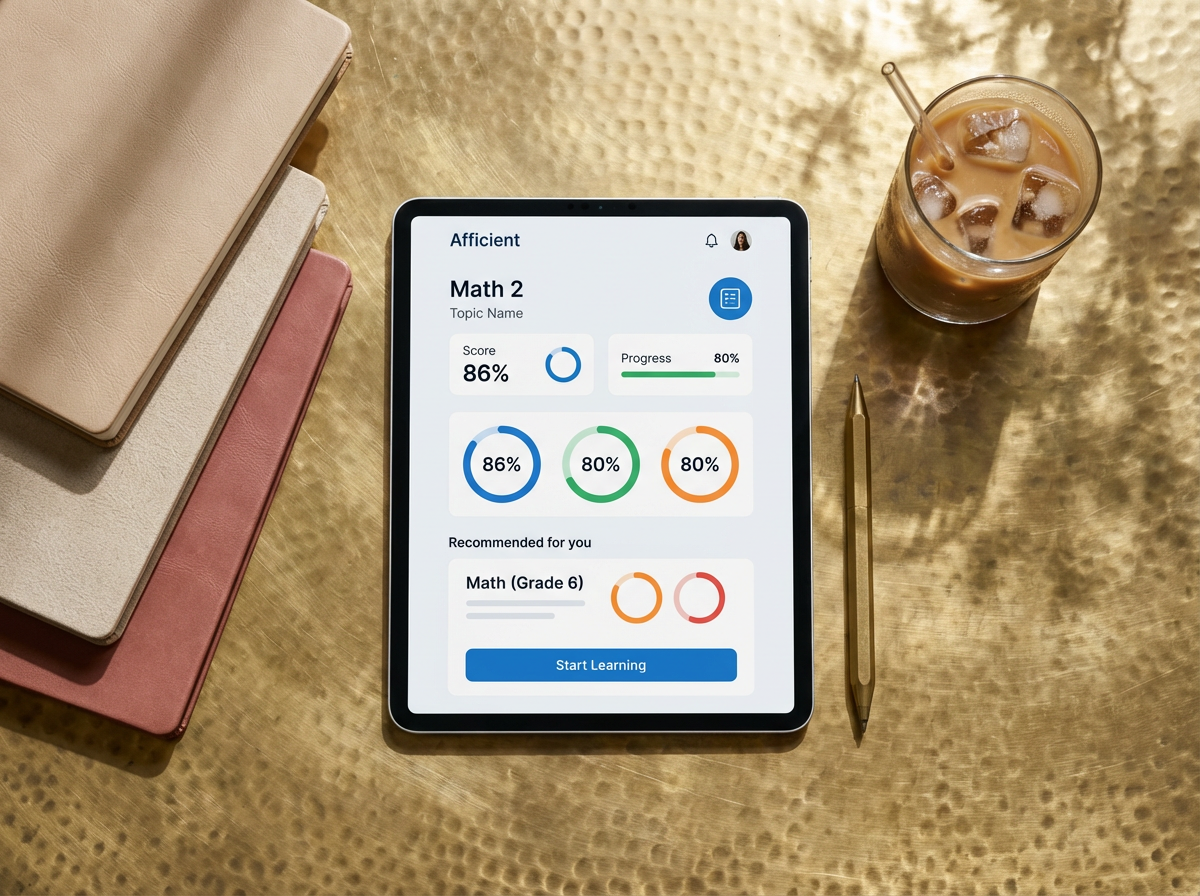
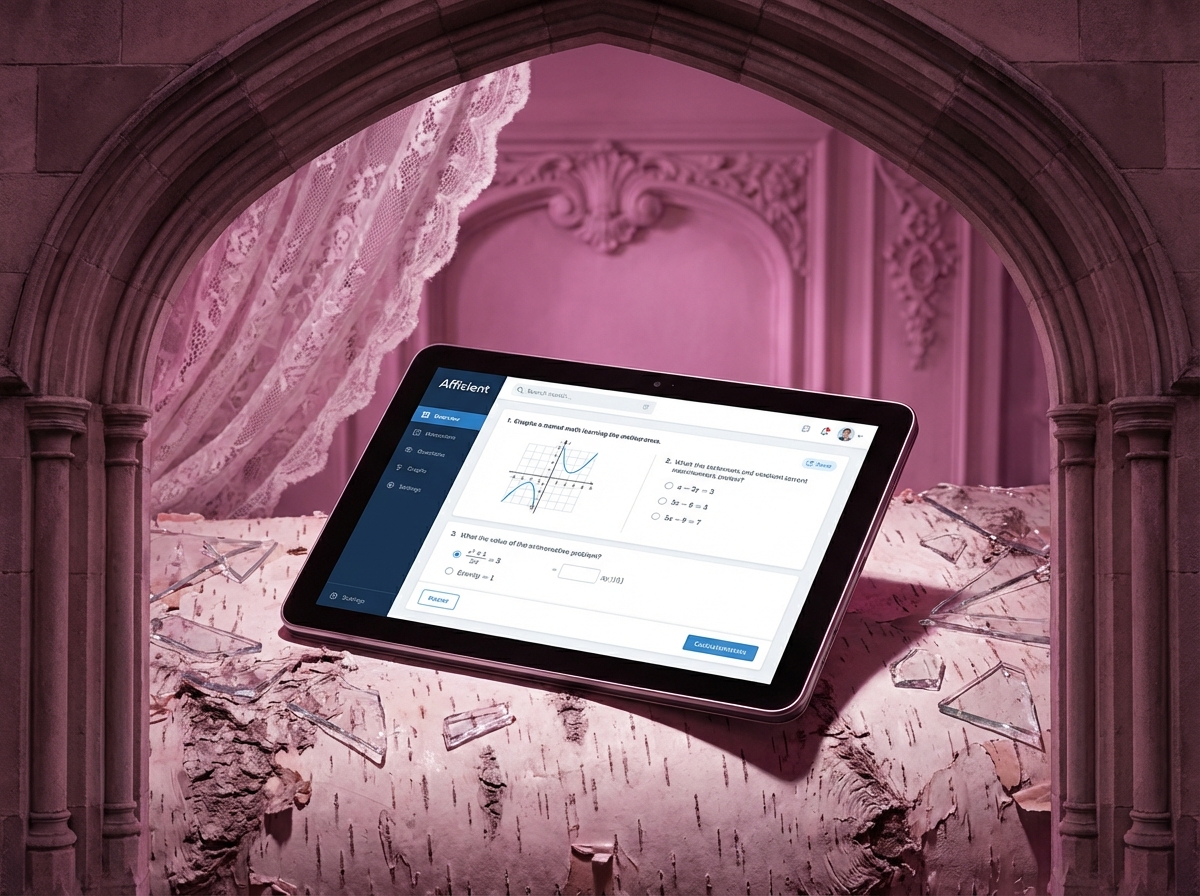
For students who need structured practice after manipulative exploration, Afficient's adaptive learning system extends these hands-on principles into digital format. The platform provides virtual manipulatives that students can rotate, resize, and combine, with immediate feedback that helps them recognize patterns and correct misconceptions in real time.
Visual Representation: Teaching Geometry Through Multiple Perspectives
Effective geometry instruction uses color-coding, labeled diagrams, and progressive visualization to make spatial relationships explicit. Middle schoolers benefit from seeing the same concept represented in multiple ways—through sketches, photographs of real objects, and dynamic digital models.
Color-coding clarifies relationships that students might otherwise miss. Marking all right angles in red, parallel lines in blue, and congruent sides with matching colors helps students identify patterns across different shapes. When analyzing quadrilaterals, color-coding reveals that rectangles, squares, and parallelograms share certain properties while differing in others—a distinction that's harder to grasp from text descriptions alone.
Annotated diagrams with clear labels prevent confusion about which measurements or angles are being discussed. Rather than saying "find the missing angle," effective instruction shows diagrams with angles labeled A, B, and C, then asks "if angle A = 45° and angle B = 60°, what is angle C?" This specificity reduces cognitive load and helps students focus on the geometric reasoning rather than decoding unclear references.
Progressive visualization moves from concrete to abstract. Start with photographs of everyday objects—a slice of pizza for triangles, a door for rectangles, a basketball for spheres. Then transition to realistic drawings, followed by simplified geometric sketches, and finally to abstract symbols and notation. This gradual progression honors the developmental stages described in van Hiele theory, where students need concrete experiences before they can work with formal definitions.
Dynamic geometry software like GeoGebra allows students to manipulate shapes and immediately see how changing one element affects others. Dragging a vertex to change a triangle's angles while watching the angle measurements update in real time makes abstract concepts like "complementary angles" or "angle-side relationships" visually obvious.
Real-World Connections: Making Geometry Relevant to Middle School Lives
Geometry stops feeling like arbitrary rules when students see it in architecture, sports, nature, and design. Connecting classroom concepts to familiar contexts provides both motivation and deeper understanding.
Sports applications resonate with many middle schoolers. Basketball courts, soccer fields, and baseball diamonds are full of geometric shapes and measurements. Calculating the area of a basketball key, understanding why corner kicks in soccer use the arc of a circle, or measuring the angles in a baseball diamond's infield makes geometry immediately relevant. Students can measure actual sports equipment—the circumference of a basketball, the dimensions of a tennis court—and use those measurements in problem-solving activities.
Architecture and interior design offer rich geometric exploration. Students can measure their classroom dimensions, calculate the area of walls for a painting project, or design a bedroom layout using scale drawings. Understanding that architects use geometric principles to ensure buildings are structurally sound and aesthetically pleasing connects middle school math to real careers.
Nature provides unexpected geometry lessons. Hexagonal honeycombs, spiral shells following Fibonacci patterns, and the bilateral symmetry of butterfly wings show that geometry isn't just a human invention—it's fundamental to how the natural world is organized. Projects like photographing geometric shapes in nature or analyzing the angles in leaf arrangements make geometry feel like discovery rather than drill.
Everyday problem-solving reinforces practical applications. How much wrapping paper is needed to cover a gift box? What's the most efficient way to arrange furniture in a room? How many tiles are needed to cover a floor? These real-world scenarios give students reasons to care about perimeter, area, and volume calculations.
Vocabulary and Concept Building: From Informal Language to Formal Terms
Middle schoolers need explicit vocabulary instruction to move from informal descriptions to precise geometric language. Building this vocabulary systematically prevents confusion and enables clear mathematical communication.
Start with informal descriptions that connect to students' existing knowledge. Before introducing "perpendicular," talk about "lines that meet at corners like the edges of a door." Before "parallel," discuss "lines that never touch, like train tracks." This approach validates students' intuitive understanding while preparing them for formal terminology.
Create visual vocabulary walls where each term is accompanied by multiple examples and non-examples. For "acute angle," show several angles less than 90° alongside obtuse and right angles for contrast. For "parallelogram," display rectangles, rhombuses, and squares (all special types of parallelograms) next to trapezoids (which are not parallelograms). This visual reference helps students develop accurate mental models.
Classification systems help organize geometric knowledge. Teaching students to classify triangles by sides (scalene, isosceles, equilateral) and by angles (acute, right, obtuse) provides a framework for understanding relationships. Similarly, organizing quadrilaterals into a hierarchy—quadrilaterals → parallelograms → rectangles/rhombuses → squares—shows how properties are inherited and specialized.
Use consistent notation and labeling conventions from the beginning. Teaching students to mark congruent sides with tick marks, congruent angles with arc marks, and right angles with small squares creates a shared visual language that makes diagrams easier to interpret.
Afficient Academy's diagnostic assessments identify which geometric vocabulary terms students have mastered and which remain unclear, then generates customized practice that reinforces terminology through varied contexts and visual examples.
Scaffolding and Differentiation: Meeting Students Where They Are
Effective geometry instruction recognizes that middle schoolers enter with vastly different spatial reasoning abilities and prior knowledge. Differentiated approaches ensure all students can access challenging content while receiving appropriate support.
The van Hiele model provides a framework for scaffolding. Students at Level 1 (visualization) recognize shapes by appearance but don't yet analyze properties. Level 2 (analysis) students can identify properties but don't see relationships between shape categories. Level 3 (informal deduction) students understand that rectangles are special parallelograms and can follow logical arguments. Instruction should meet students at their current level while providing experiences that move them toward the next stage.
Diagnostic pre-assessments reveal specific gaps. Before teaching a unit on quadrilaterals, assess whether students can identify right angles, understand parallel lines, and measure side lengths accurately. Students who lack these prerequisite skills need targeted intervention before tackling more complex classification tasks.
Provide multiple entry points for the same concept. When teaching area, offer concrete options (counting unit squares on grid paper), visual options (using formulas with clearly labeled dimensions), and abstract options (deriving area formulas from first principles). This allows students to engage at their readiness level while being exposed to more sophisticated approaches.
Use flexible grouping based on specific skill needs rather than general ability levels. A student who excels at angle measurement might need support with 3D visualization, while another student shows the opposite pattern. Grouping students by specific learning needs for targeted mini-lessons is more effective than static ability grouping.
Platforms like Afficient Academy excel at this differentiation by continuously assessing student understanding and adjusting problem difficulty in real time. When a student struggles with triangle classification, the system provides additional practice with visual hints before moving forward. When a student demonstrates mastery, the platform introduces extension challenges that deepen understanding without waiting for the whole class to catch up.
Implementation Strategies for Teachers and Parents
Successful geometry instruction requires intentional planning and consistent support both in school and at home.
Teachers should structure lessons with a concrete-to-abstract progression. Begin each new concept with hands-on exploration using manipulatives, move to visual representation through drawings and diagrams, then progress to abstract notation and formal reasoning. Allocate 15-20 minutes of each geometry lesson to manipulative work, even as students advance to more abstract thinking.
Assessment should go beyond procedural fluency. Include tasks that require students to explain their reasoning, identify errors in flawed arguments, and apply geometric concepts to novel situations. Performance tasks like "design a playground that includes at least three different quadrilaterals and calculate the total area" assess deeper understanding than multiple-choice tests.
Parents can support geometry learning through everyday activities. Cooking provides opportunities to discuss fractions, measurement, and volume. Home improvement projects involve perimeter and area calculations. Even video games often incorporate geometric problem-solving that parents can highlight and discuss.
Technology integration should complement, not replace, hands-on learning. Use dynamic geometry software to extend manipulative exploration, not as a substitute for physical materials. Afficient Academy's progress tracking and teacher reports help educators track which students are struggling with specific concepts, enabling timely intervention and small-group support.
Comparison: Traditional vs. Interactive Geometry Learning Approaches
| Aspect | Traditional Textbook Approach | Interactive Hands-On Approach |
|---|---|---|
| Primary Learning Mode | Reading definitions, memorizing formulas | Manipulating objects, discovering properties through exploration |
| Visualization | Static printed diagrams | Dynamic manipulatives, digital tools, real-world objects |
| Concept Introduction | Abstract definitions first | Concrete experiences leading to formal understanding |
| Practice Format | Repetitive worksheet problems | Varied activities including building, measuring, designing |
| Differentiation | Same problems for all students | Adaptive difficulty based on individual readiness |
| Real-World Connection | Occasional word problems | Integrated authentic applications and project-based learning |
| Assessment Focus | Procedural accuracy | Conceptual understanding and reasoning |
| Technology Role | Minimal or supplementary | Integrated for visualization and personalized practice |
Frequently Asked Questions
Q: What specific manipulatives work best for middle school geometry?
A: Pattern blocks, geoboards, geometric solids (cubes, prisms, pyramids), protractors, compasses, and folding paper are essential. Tangrams help with shape composition, while straws and connectors allow 3D construction. Digital alternatives like GeoGebra provide virtual manipulation when physical materials aren't available.
Q: How can I help my middle schooler who struggles with spatial reasoning?
A: Start with concrete activities like building with blocks, solving tangram puzzles, and identifying shapes in everyday objects. Practice mental rotation by having them predict how shapes look from different angles. Afficient's adaptive system identifies specific spatial reasoning gaps and provides targeted visual exercises that build these skills systematically.
Q: Should middle schoolers memorize geometry formulas or understand how they work?
A: Understanding should come first. When students discover that a rectangle's area equals length × width by counting unit squares, the formula becomes meaningful rather than arbitrary. Memorization follows naturally from repeated use in context. Focus on why formulas work, not just what they are.
Q: How much geometry practice is needed outside of class?
A: Quality matters more than quantity. Three focused 15-minute sessions per week with varied activities (manipulatives, real-world applications, visual puzzles) typically yield better results than daily repetitive worksheets. Adaptive platforms adjust practice time based on individual mastery, ensuring efficient skill development.
Take Action: Supporting Your Middle Schooler's Geometry Success
Making geometry easier for middle schoolers requires shifting from abstract memorization to concrete, visual, and interactive learning experiences. When students can touch, manipulate, and see geometric concepts in action—whether through physical manipulatives, real-world applications, or adaptive digital tools—spatial reasoning develops naturally and problem-solving confidence grows.
To support your middle schooler's geometry journey with research-backed, adaptive tools that combine visual learning principles with personalized practice, explore how Afficient Academy builds geometric understanding through interactive discovery at afficienta.com.