
Adaptive Math Apps for Kids: How to Find One That Truly Matches Your Child's Pace in 2026
The best math practice app that adapts to your child's level uses AI-powered algorithms to create personalized learning paths, adjusting difficulty in real-time based on performance. In 2026, adaptive math apps like Afficient Academy have revolutionized elementary education by offering intelligent diagnostic assessments, dynamic content adjustment, and transparent parent dashboards—ensuring each child progresses at their optimal pace while mastering grade-level standards. Unlike generic one-size-fits-all programs, truly adaptive platforms identify knowledge gaps, provide targeted practice, and align with curriculum standards like Common Core to deliver measurable results.
What Makes a Math App Truly Adaptive?
Genuine adaptive technology goes beyond simple difficulty progression—it requires real-time performance analysis and intelligent content selection. The most effective adaptive math apps use patented algorithms to analyze every answer, response time, and error pattern to build a comprehensive understanding of your child's mathematical strengths and weaknesses. This continuous assessment allows the system to adjust not just difficulty levels, but also the types of problems presented, the scaffolding provided, and the pacing of new concept introduction.
Key features of truly adaptive math learning include:
- Real-time difficulty adjustment that responds immediately to student performance
- Intelligent scaffolding that breaks down complex concepts when students struggle
- Mastery-based progression that prevents advancement until foundational skills are solid
- Diagnostic assessments that pinpoint specific skill gaps
- Personalized learning paths unique to each student's knowledge profile
Afficient Math exemplifies this approach with its patented algorithm technology that creates individualized learning journeys from 1st grade through pre-calculus. The system continuously recalibrates based on student responses, ensuring that practice sessions remain challenging yet achievable—the optimal zone for accelerated learning.
Top 8 Adaptive Math Apps for Elementary Students in 2026
Afficient Academy Math
Best for: Data-driven parents seeking measurable progress with comprehensive curriculum coverage
Afficient stands out for its WASC-accredited curriculum and proven track record—over 90% of students complete a full grade-level advancement within 2-5 months while achieving A/A+ grades. Based on data from 7,831 students (2018-2022), students in grades 1-6 average 2 months to complete grade-level advancement. The platform covers content from 1st grade through pre-calculus, all aligned with Common Core standards.
Core features include:
- Patented adaptive algorithm with instant scoring
- Smart path adjustment based on real-time performance
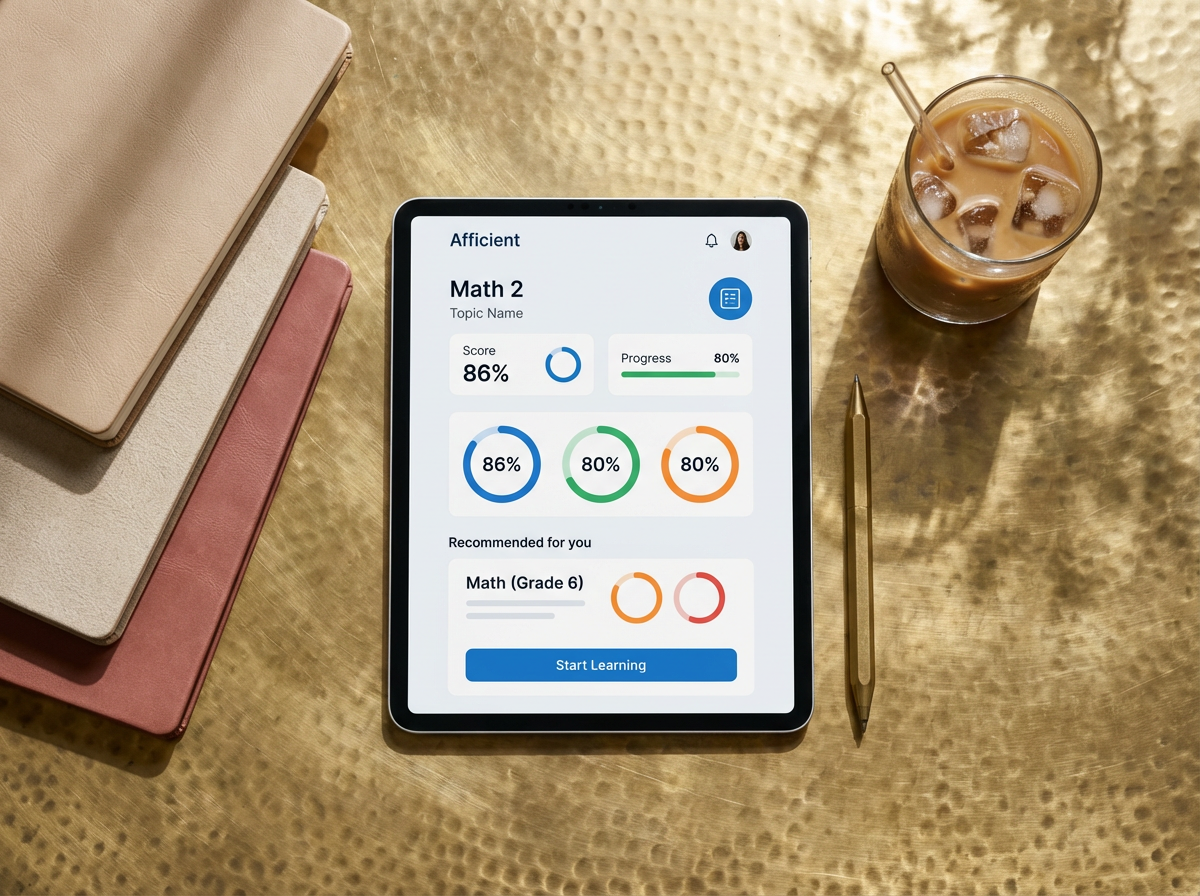
- Afficient Progress companion app for parent monitoring
- Optional certified teacher support (online or in-person)
- Comprehensive progress tracking with detailed analytics
Pricing: Premium subscription with optional tutoring packages
Age range: Grades 1-12
Parent feedback: Renee Li noted her child's continued engagement after 2 months, while Alien Ack reported significant test score improvements after summer daily practice.
Khan Academy Kids
Best for: Budget-conscious families seeking free foundational content
Khan Academy Kids offers completely free adaptive math content for younger learners, with colorful animations and game-based activities. The platform adjusts difficulty based on performance but lacks the granular progress analytics that data-focused parents prefer.
Strengths: Entirely free, engaging interface, covers multiple subjects
Limitations: Less detailed progress tracking, limited parent dashboard features
Age range: Ages 2-8
DreamBox Learning
Best for: Visual learners who benefit from manipulative-based instruction
DreamBox uses virtual manipulatives and visual models to teach mathematical concepts, with adaptive technology that adjusts both content and instructional approach. The platform is particularly strong in developing conceptual understanding rather than just procedural fluency.
Strengths: Excellent visual representations, strong conceptual focus
Limitations: Higher price point, can feel less game-like for some students
Age range: K-8
Prodigy Math
Best for: Students motivated by game-based rewards and fantasy elements
Prodigy wraps math practice in a fantasy RPG adventure where students answer questions to battle creatures and progress through storylines. While highly engaging, the game elements can sometimes distract from focused learning.
Strengths: High engagement through gamification, curriculum-aligned content
Limitations: Game elements may distract some learners, ads in free version
Age range: Grades 1-8
IXL Math
Best for: Comprehensive skill coverage with extensive practice problems
IXL offers an enormous library of practice problems across all grade levels with immediate feedback. The platform tracks progress through skill mastery but uses a more traditional drill-and-practice approach compared to newer adaptive systems.
Strengths: Comprehensive skill coverage, detailed progress reports
Limitations: Interface can feel repetitive, less personalized explanations
Age range: Pre-K through 12th grade
Zearn Math
Best for: Schools and families wanting video lessons alongside practice
Zearn combines video instruction with adaptive digital lessons, making it ideal for students who benefit from explicit teaching before practice. The platform closely follows Eureka Math curriculum.
Strengths: Integrated video lessons, strong teacher resources
Limitations: Less flexibility in learning path, designed primarily for school use
Age range: K-5
ST Math
Best for: Visual-spatial learners and students with language barriers
ST Math uses a visual, game-based approach with minimal language, making it accessible for English language learners and students who think spatially. The adaptive system adjusts challenge levels based on student interaction patterns.
Strengths: Language-independent visual approach, strong spatial reasoning development
Limitations: Less traditional practice format, requires different learning mindset
Age range: K-8
Mathseeds
Best for: Early elementary students beginning their math journey
Mathseeds focuses on foundational math skills for younger learners with colorful animations and reward systems. The adaptive components are simpler than advanced platforms but appropriate for the target age group.
Strengths: Engaging for young children, clear skill progression
Limitations: Limited to early elementary, less sophisticated adaptation
Age range: Ages 3-9
Quick Comparison: Adaptive Math Apps 2026
| App | Adaptive Technology | Progress Tracking | Curriculum Alignment | Price Range | Best For |
|---|---|---|---|---|---|
| Afficient | Patented real-time algorithm | Detailed parent analytics | Common Core (Grades 1-12) | Premium | Data-driven parents, proven results |
| Khan Academy Kids | Basic adaptation | Limited dashboard | Age-appropriate standards | Free | Budget-conscious families |
| DreamBox | Advanced visual adaptation | Comprehensive reports | Common Core (K-8) | $$$ | Visual learners |
| Prodigy | Game-integrated adaptation | Standard progress view | Curriculum-aligned | Free-$$ | Game-motivated students |
| IXL | Skill-based progression | Detailed skill tracking | Comprehensive standards | $$ | Extensive practice needs |
| Zearn | Lesson + practice adaptation | Teacher-focused reports | Eureka Math aligned | Free-$ | Video instruction preference |
| ST Math | Visual-spatial adaptation | School-focused tracking | Standards-aligned | $$$ | Visual-spatial learners |
| Mathseeds | Simple early adaptation | Basic parent view | Early math standards | $ | Ages 3-9 |
How to Choose the Right Adaptive Math App for Your Child
Start by identifying your child's specific learning needs and your family's priorities. Not all adaptive apps serve the same purpose—some excel at filling knowledge gaps, others at accelerating advanced learners, and still others at building conceptual understanding. Consider these key selection criteria:
Assess the depth of adaptivity. Does the app simply increase problem difficulty, or does it intelligently adjust instructional approach, scaffolding, and content sequencing? Afficient's patented algorithm exemplifies sophisticated adaptation by analyzing error patterns to identify root causes of misunderstanding, then providing targeted remediation before advancing.
Evaluate progress transparency. Can you clearly see what your child is learning, where they're struggling, and how they're improving? Apps like Afficient provide detailed parent dashboards with skill mastery heat maps and daily progress summaries, enabling data-driven decisions about your child's learning journey.
Verify curriculum alignment. Ensure the app covers your state's standards or Common Core requirements. This prevents gaps between school curriculum and supplemental practice. Afficient offers comprehensive Common Core coverage from 1st grade through pre-calculus, ensuring seamless integration with classroom learning.
Consider engagement vs. distraction balance. While gamification increases motivation, excessive game elements can shift focus from learning to entertainment. Look for apps that maintain educational focus while providing appropriate rewards for effort and achievement.
Test the diagnostic capabilities. Strong adaptive systems begin with thorough diagnostic assessments to establish baseline knowledge. SAT student Jen Zhen specifically praised Afficient's ability to identify weak areas and build confidence through progressively challenging content.
Factor in your involvement level. Some apps require minimal parent oversight, while others benefit from active parent engagement. Choose based on your available time and preferred involvement level in your child's supplemental learning.
Real-World Results: What Parents Report in 2026
The most compelling evidence for adaptive math apps comes from measurable student outcomes. Based on comprehensive data analysis, truly adaptive platforms demonstrate significant learning acceleration compared to traditional practice methods.
Afficient Academy's results stand out: over 90% of students complete a full grade-level advancement within 2-5 months while maintaining A/A+ performance levels. Analysis of 7,831 students between 2018-2022 shows that students in grades 1-6 average 2 months to complete grade-level advancement.
Parent testimonials reinforce these quantitative results. Renee Li reported that after just 2 months with Afficient, her child's engagement and progress convinced the family to continue the program long-term. Alien Ack shared that daily summer practice successfully identified and filled learning gaps, leading to noticeably improved test scores in the following school year.
Key success factors parents identify:
- Consistent daily practice (15-30 minutes recommended)
- Parent monitoring through progress dashboards
- Alignment between app content and school curriculum
- Immediate feedback preventing error pattern reinforcement
- Mastery-based advancement ensuring solid foundations
Understanding Adaptive Learning Technology
Adaptive learning technology uses artificial intelligence to create dynamic, personalized educational experiences. Unlike static curricula that present the same content sequence to all students, adaptive systems continuously analyze performance data to optimize each learner's path.
The core components of effective adaptive systems include:
Diagnostic assessment engines that evaluate not just whether answers are correct, but why errors occur. These systems identify whether mistakes stem from conceptual misunderstanding, procedural errors, or simple carelessness—then adjust instruction accordingly.
Intelligent content selection algorithms that choose optimal next problems based on current skill level, learning velocity, and knowledge gaps. Rather than linear progression, these systems may revisit prerequisite skills, introduce new concepts, or provide enrichment based on individual needs.
Real-time difficulty calibration that maintains optimal challenge levels—difficult enough to promote growth but achievable enough to prevent frustration. This "zone of proximal development" maximizes learning efficiency.
Scaffolding mechanisms that provide graduated support when students struggle, offering hints, worked examples, or alternative explanations before allowing further attempts.
Progress tracking systems that aggregate performance data into actionable insights for parents and educators, highlighting mastery levels, learning velocity, and areas requiring additional support.
Common Concerns About Adaptive Math Apps
Q: Do adaptive math apps really work, or is it just marketing hype?
A: Research and real-world data confirm that high-quality adaptive systems significantly accelerate learning. Afficient's documented results—90%+ of students advancing a full grade level in 2-5 months—demonstrate measurable effectiveness. The key is choosing platforms with sophisticated adaptation algorithms, not simple difficulty progression. Look for apps with published efficacy data and specific outcome metrics.
Q: How do I know if an app is truly adapting to my child's level or just moving through preset content?
A: Genuine adaptive systems show visible response to student performance. Test this by intentionally answering several problems incorrectly—a truly adaptive app will immediately adjust by providing easier problems or additional instruction. Review the app's technical documentation for terms like "real-time algorithm," "intelligent scaffolding," or "dynamic path adjustment." Afficient's patented adaptive technology and instant scoring exemplify true adaptation.
Q: Will my child become too dependent on the app and struggle with traditional math work?
A: Quality adaptive apps complement rather than replace traditional instruction. They're most effective as supplemental practice tools that reinforce classroom learning. Choose apps aligned with your school's curriculum standards to ensure consistency. Afficient's Common Core alignment ensures that skills developed through the app transfer directly to classroom success.
Q: How much time should my child spend on an adaptive math app daily?
A: Most experts recommend 15-30 minutes of focused daily practice for optimal results without burnout. Consistency matters more than duration—daily short sessions typically outperform infrequent longer sessions. Parent Alien Ack reported success with daily summer practice, which effectively addressed learning gaps and improved subsequent test performance.
Take Action: Finding Your Child's Ideal Math Learning Partner
Choosing the right adaptive math app transforms supplemental practice from frustrating drill work into engaging, effective learning. Start by clearly defining your goals—are you addressing specific skill gaps, accelerating an advanced learner, building confidence, or preparing for standardized tests?
For parents seeking data-driven results with comprehensive curriculum coverage, Afficient Academy offers proven effectiveness backed by quantitative outcomes and parent testimonials. The platform's patented adaptive algorithm, detailed progress tracking through the Afficient Progress app, and optional certified teacher support create a complete learning ecosystem. With WASC-accredited curriculum covering grades 1-12 and alignment to Common Core standards, Afficient provides the sophisticated adaptation and transparency that data-focused parents value.
Visit afficienta.com to explore how Afficient's intelligent adaptive technology can create a personalized learning path that matches your child's unique pace and helps them achieve measurable academic growth.
Whether you choose Afficient or another platform, prioritize apps with genuine adaptive technology, transparent progress tracking, and curriculum alignment. Your child deserves supplemental practice that adapts to their needs rather than forcing them to adapt to rigid content sequences. In 2026, the best adaptive math apps don't just teach mathematics—they build confidence, accelerate mastery, and create lifelong learners.