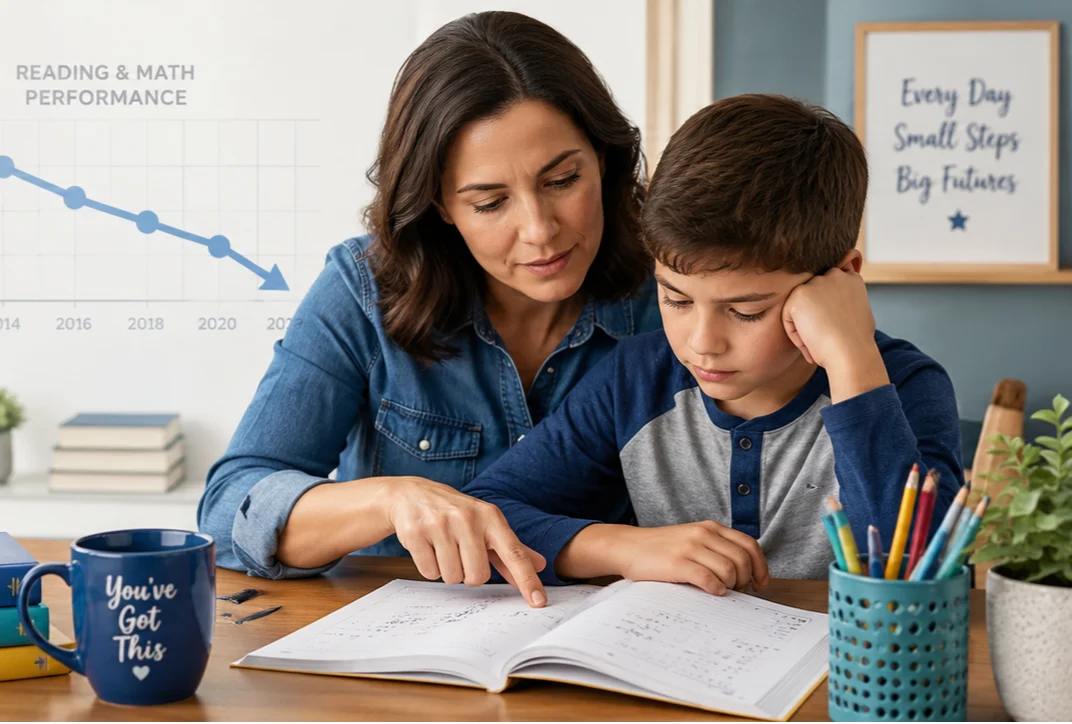

Every parent dreads that moment: your child comes home frustrated, their geometry homework untouched, eyes welling with tears. “I just don’t get it, Mom. Nothing makes sense.” While other math subjects might have clicked, geometry feels like a foreign language—one filled with proofs, theorems, and spatial puzzles that seem impossible to decode.
If this sounds familiar, you’re not alone. Geometry represents one of the most significant academic hurdles in middle and high school mathematics, and the struggle is real, urgent, and surprisingly common.
Why Geometry Hits Different: Understanding the Unique Challenge
Geometry requires a fundamentally different type of thinking than other math subjects. While algebra relies on symbolic manipulation and arithmetic on numerical operations, geometry demands visual-spatial reasoning—the ability to mentally manipulate shapes, understand relationships between objects in space, and construct logical arguments about what you see.
This cognitive shift catches many students off guard. A child who excels at solving equations might suddenly flounder when asked to prove why two triangles are congruent. The abstract nature of geometric proofs, combined with the need to visualize three-dimensional objects on a two-dimensional page, creates a perfect storm of confusion.
Common geometry struggles include:
- Difficulty visualizing shapes and their transformations
- Confusion about when and how to apply theorems
- Inability to construct logical proofs step-by-step
- Trouble translating word problems into diagrams
- Frustration with the “why” behind geometric relationships
The pain is compounded by the fact that geometry often serves as a gatekeeper course. Poor performance can affect college applications, limit advanced math opportunities, and damage a student’s mathematical confidence for years to come.
The Hidden Cost of Falling Behind in Geometry
When a child struggles in geometry class, time becomes the enemy. Unlike subjects where you can catch up by memorizing facts, geometry builds conceptually. Miss the foundation of triangle congruence, and you’ll struggle with similarity. Fail to grasp coordinate geometry, and analytic proofs become impossible.
Parents often try traditional solutions: hiring local tutors, purchasing workbooks, or spending hours at the kitchen table trying to explain concepts they barely remember themselves. Yet these approaches frequently fall short because they don’t address the root cause—geometry requires multiple representations and personalized identification of exactly where understanding breaks down.
Discover your child’s specific geometry gaps with a free diagnostic assessment that pinpoints exactly where confusion begins.
What Actually Works: Evidence-Based Geometry Learning Strategies
Effective geometry instruction requires three critical elements: visual learning approaches, multiple solution methods, and targeted identification of misconceptions. Research consistently shows that students master geometry when they can see concepts from different angles—literally and figuratively.
Visual learning approaches transform abstract concepts into concrete understanding. Instead of simply reading that “the sum of angles in a triangle equals 180 degrees,” students need to see multiple triangles, measure their angles, and discover the pattern themselves. Dynamic geometry software, interactive diagrams, and multiple visual representations help build the spatial reasoning that geometry demands.
Multiple solution methods acknowledge that geometry problems rarely have just one path to the answer. A single problem might be solved through algebraic manipulation, pure geometric reasoning, or coordinate geometry approaches. When students learn multiple methods, they develop flexibility and deeper conceptual understanding.
Targeted misconception identification addresses the reality that geometry confusion isn’t random. Students make predictable errors based on incomplete mental models. Perhaps they believe all quadrilaterals with equal sides are squares, or they confuse similarity with congruence. Identifying these specific misconceptions—rather than just marking answers wrong—enables precise intervention.
The AI Advantage: How Technology Transforms Geometry Learning
Modern AI-powered learning systems offer something traditional tutoring cannot: the ability to analyze thousands of student responses, identify patterns in confusion, and adapt instruction in real-time. This isn’t about replacing human teachers—it’s about augmenting their effectiveness with data-driven insights.
Afficient Academy leverages U.S. patented AI technology to provide geometry support that addresses the subject’s unique challenges. The system doesn’t just check if answers are correct; it analyzes how students arrive at those answers, identifying gaps in spatial reasoning and conceptual understanding that human tutors might miss.
Key advantages of Afficient’s geometry approach include:
Visual aids and multiple diagrams that present concepts from different perspectives, helping students build robust mental models of geometric relationships.
AI-powered identification of spatial thinking gaps that goes beyond surface-level errors to understand why a student is confused—whether it’s a visualization problem, a logic gap, or a misconception about geometric properties.
Multiple solution methods for every problem, showing algebraic, geometric, and coordinate approaches side-by-side so students can choose the method that makes most sense to them.
Step-by-step proof guidance that breaks down logical reasoning into manageable chunks, teaching students not just what to write but how to think through geometric arguments.
Error pattern analysis that recognizes when a student consistently makes the same type of mistake, indicating a deeper conceptual misunderstanding that needs targeted intervention.
Targeted concept breakdown that isolates specific geometry struggles—whether it’s triangle congruence, circle theorems, or coordinate geometry—and provides focused practice until mastery is achieved.
The results speak for themselves: over 90% of Afficient students improve by one grade level and achieve A or A+ grades within 2-5 months, transforming from confused and frustrated to confident and capable.
See how Afficient makes geometry click with a free evaluation that shows exactly how AI-powered learning can help your child.
Real Success Stories: From Geometry Struggles to Breakthroughs
Alien Ack’s daughter faced a common scenario: summer break approaching with significant geometry gaps that threatened next year’s success. “We used Afficient Math over the summer to fill in knowledge gaps,” Alien explains. “The program identified exactly where she was struggling and provided targeted practice. Her test scores improved dramatically.”
Jen Zhen discovered the power of precise diagnostics when her child prepared for standardized tests. “The SAT program was able to identify weak points and provide targeted practice problems. The AI adaptation meant my child wasn’t wasting time on concepts already mastered—every minute focused on actual gaps.”
Renee Li emphasizes the human element that complements the technology. “The tutors are patient and professional. They understand different learning styles and adjust their teaching methods accordingly. My child finally understood proofs because the tutor could explain the same concept three different ways until it clicked.”
These aren’t isolated cases. The combination of AI-powered diagnostics, adaptive learning paths, and expert human support creates an environment where geometry breakthroughs become the norm rather than the exception.
Taking Action: Your Child’s Geometry Success Starts Now
Geometry struggles don’t have to define your child’s math journey. With the right support—combining visual learning, multiple representations, AI-powered diagnostics, and expert guidance—students who once felt lost in geometry class can become confident problem-solvers who actually enjoy the subject.
The key is acting quickly. Every day your child spends confused in geometry class compounds the problem, making catch-up harder and damaging mathematical confidence. But with targeted intervention that addresses the specific nature of geometric thinking, transformation can happen remarkably fast.
Afficient Academy’s comprehensive geometry support covers everything from elementary geometry basics through advanced high school courses. The AI system continuously adapts to your child’s progress, ensuring they’re always working at the optimal challenge level—not so easy that they’re bored, not so hard that they’re overwhelmed.
Real human tutors monitor progress, provide conceptual explanations when AI-generated hints aren’t enough, and offer the encouragement that keeps students motivated through challenging material. It’s the best of both worlds: the precision and adaptability of artificial intelligence combined with the empathy and expertise of experienced educators.
Take the free diagnostic test to identify and fix your child’s geometry struggles before they become permanent roadblocks.
Your child’s geometry breakthrough is closer than you think. With the right tools, targeted support, and proven methods, those tears of frustration can transform into smiles of accomplishment. Geometry doesn’t have to be the bottleneck—it can become the breakthrough that builds lasting mathematical confidence.