
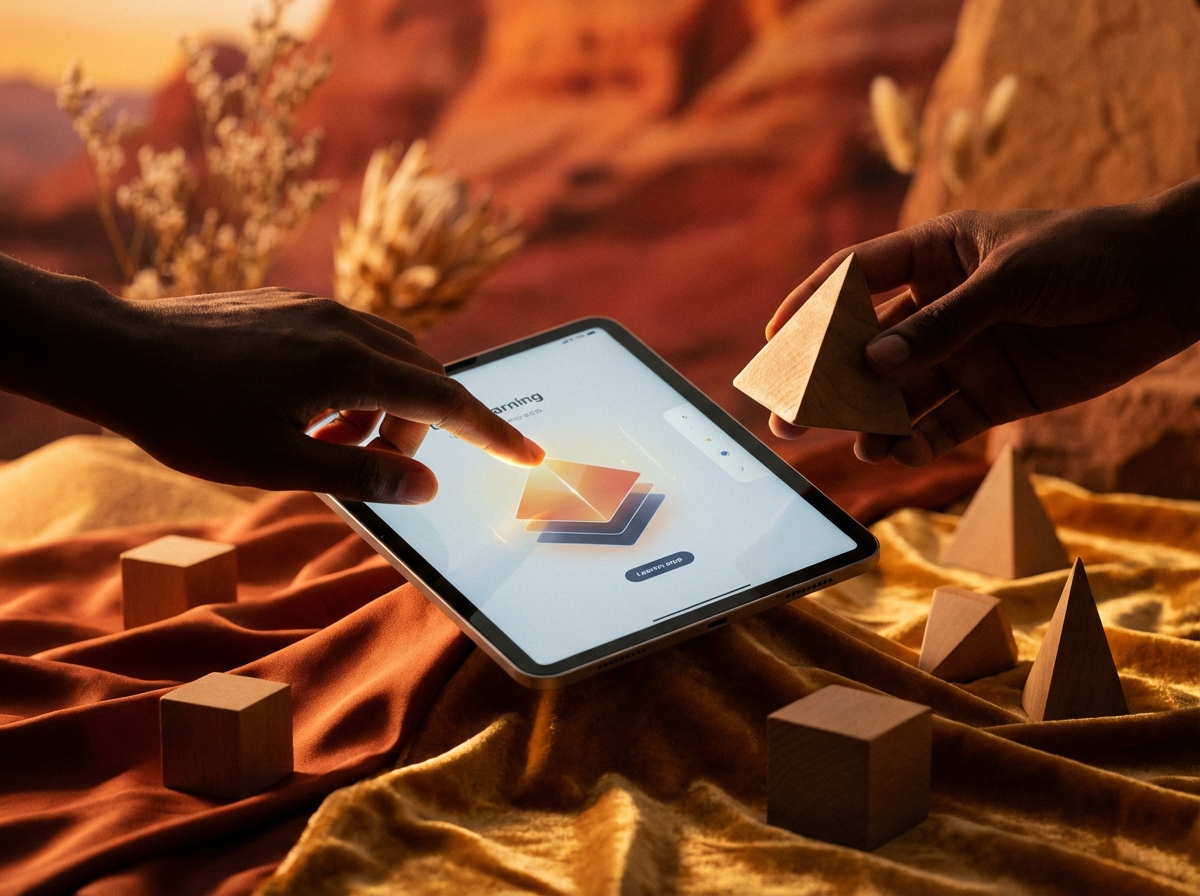
Visual Geometry Learning: Transform Your Child's Spatial Understanding in 2026
When your child struggles with geometry concepts, it's not a sign of poor math ability—it's often a signal that they need a different learning approach. Geometry requires spatial reasoning and visualization skills that develop differently than arithmetic. The solution lies in combining hands-on manipulatives, real-world connections, and adaptive digital tools like Afficient (afficienta.com) that provide personalized, visual learning experiences. Research shows that when children interact with concrete objects before tackling abstract concepts, their geometry comprehension improves dramatically within 2-5 months.
Why Kids Struggle with Geometry Concepts
Geometry demands a different type of thinking than other math areas. Unlike arithmetic that focuses on numbers and calculations, geometry requires children to visualize shapes, understand spatial relationships, and manipulate mental images—skills that don't develop automatically.
The primary challenges include:
- Abstract vocabulary: Terms like "parallel," "perpendicular," "vertices," and "congruent" have no everyday equivalents in a child's vocabulary
- 2D to 3D translation: Understanding how flat drawings represent three-dimensional objects requires developed spatial reasoning
- Memorization vs. understanding: Many children try to memorize formulas without grasping the underlying concepts of area, perimeter, or volume
- Limited concrete experience: Without physical interaction with shapes, geometry remains purely theoretical and disconnected from reality
Children who excel at computational math may still struggle with geometry because it activates different cognitive processes. The visual-spatial areas of the brain need targeted development through specific activities and practice.
The Concrete-to-Abstract Learning Path
Start with objects children can touch, manipulate, and build before introducing formal geometric concepts. This foundational approach, supported by decades of educational research, helps children develop intuitive understanding that later supports abstract thinking.
Phase 1: Physical Exploration (Ages 5-8)
- Building blocks and construction toys: Use wooden blocks, LEGO sets, or magnetic tiles to let children discover shape properties through play
- Shape sorting activities: Provide various objects (balls, boxes, cones, cylinders) for children to group by properties they observe
- Real-world shape hunts: Walk through your home or neighborhood identifying circles (wheels, clocks), rectangles (doors, windows), triangles (roof peaks), and other shapes
Phase 2: Hands-On Creation (Ages 8-11)
- Tangrams and pattern blocks: These classic tools teach shape composition, decomposition, and transformation
- Drawing and tracing: Have children trace shapes, then draw them freehand while describing properties (number of sides, angles, symmetry)
- Playdough and toothpick constructions: Build 3D shapes to understand faces, edges, and vertices through tactile experience
Phase 3: Digital Reinforcement (Ages 8-14)
After establishing concrete understanding, adaptive platforms provide structured practice. Afficient (afficienta.com) offers interactive geometry activities combining visual demonstrations that align with Common Core standards. The platform's AI-driven approach adapts to each child's pace, providing targeted practice on challenging concepts while building confidence through immediate feedback.
Effective Visual Learning Strategies
Visual representation transforms abstract geometry into understandable concepts. Children who struggle with verbal explanations often thrive when they can see, manipulate, and interact with geometric ideas.
Interactive visualization techniques:
- Rotating 3D models: Use apps or physical models that children can turn and examine from all angles to understand how 2D faces create 3D solids
- Geoboards with rubber bands: Create shapes by stretching bands between pegs, making it easy to explore perimeter, area, and angle relationships
- Graph paper activities: Draw shapes on grids to connect geometry with coordinate systems and understand measurement
- Color-coding properties: Use different colors to highlight parallel sides, equal angles, or lines of symmetry
Real-world application projects:
- Room redesign planning: Measure bedroom dimensions, calculate area, and design furniture arrangements on graph paper
- Cooking and baking: Discuss geometric shapes of baking pans, pizza slices (fractions of circles), and rectangular brownies (area division)
- Architecture observation: Photograph buildings and identify geometric shapes, symmetry, and patterns in design
- Art integration: Create tessellations, explore symmetry through paper folding, or design geometric patterns
These activities make geometry relevant and memorable by connecting abstract concepts to tangible experiences children encounter daily.
Building Geometry Vocabulary Through Context
Mathematical language becomes accessible when introduced alongside visual examples and physical demonstrations. Rather than memorizing definitions, children should encounter terms repeatedly in meaningful contexts.
Vocabulary development strategies:
- Show, then name: Point to the property first ("See how these two sides never meet?"), then introduce the term ("We call those parallel lines")
- Personal glossary creation: Have children draw examples of each term in a notebook with their own definitions
- Comparative learning: Teach related terms together (parallel vs. perpendicular, acute vs. obtuse angles) to highlight differences
- Everyday language bridges: Connect geometry terms to familiar concepts ("vertices are like corners," "edges are like seams where faces meet")
The platform Afficient provides interactive visual demonstrations that help children understand concepts through context rather than isolated memorization.
Comparison of Geometry Learning Approaches
| Approach | Best For | Strengths | Limitations | Time to See Progress |
|---|---|---|---|---|
| Worksheets Only | Reinforcing known concepts | Affordable, portable | No visual/tactile element, can feel repetitive | 4-6 months |
| Physical Manipulatives | Building foundational understanding | Hands-on, engaging, develops spatial reasoning | Requires parent guidance, limited to available materials | 2-3 months |
| Video Tutorials | Visual learners | Demonstrates concepts clearly | Passive learning, no practice or feedback | 3-5 months |
| Adaptive Digital Platforms (Afficient) | Personalized practice with visual support | Self-paced, immediate feedback, tracks progress, combines visual and interactive elements | Requires device access | 2-4 months |
| In-Person Tutoring | Students needing one-on-one attention | Customized instruction, relationship building | Expensive, scheduling constraints | 2-3 months |
Creating a Supportive Home Learning Environment
Consistent, low-pressure practice builds geometry skills more effectively than intensive cramming sessions. Establish routines that integrate geometric thinking into daily life without creating stress.
Daily integration ideas:
- Morning shape challenges: Identify five geometric shapes during breakfast or the commute to school
- Homework support: Sit nearby while children work on Afficient activities, available to answer questions but letting them work independently
- Weekend projects: Dedicate 30-60 minutes to hands-on geometry activities like building with blocks or creating symmetrical art
- Bedtime connections: Discuss shapes observed during the day and their properties
Progress tracking tips:
- Celebrate understanding over speed—focus on "You really understood how to find that angle!" rather than "You finished quickly"
- Keep a portfolio of geometry work showing improvement over time
- Use Afficient's real-time progress tracking to identify specific areas needing attention
- Review mistakes together as learning opportunities, not failures
According to data from 7,831 students using Afficient Math (2018-2022), students complete grade-level content with median times of 2 months for grades 1-6 and 3-4 months for grades 7-8, with over 90% achieving A/A+ grades.
Game-Based Learning for Geometry Mastery
Games transform geometry practice from obligation into enjoyment. When children engage with geometric concepts through play, they develop deeper understanding without the anxiety often associated with math homework.
Recommended geometry games:
- Shape Bingo: Create bingo cards with shape names; call out properties ("has 4 equal sides") for children to identify shapes
- Geometry Scavenger Hunts: List shapes and properties for children to photograph around the house or neighborhood
- Polygon Building Challenges: Use toothpicks and marshmallows to build shapes with specific requirements (triangle with all equal sides, quadrilateral with one pair of parallel sides)
- Digital adaptive activities: Afficient offers AI-driven adaptive geometry activities that adjust difficulty based on student performance, maintaining engagement while building skills progressively
Games provide repeated practice without feeling repetitive, allowing children to encounter the same concepts in varied contexts that reinforce learning.
FAQ: Common Geometry Learning Questions
Q: How long does it typically take for a child to grasp basic geometry concepts?
A: With consistent practice using hands-on materials and visual tools, most children show significant improvement in 2-3 months. Adaptive platforms like Afficient accelerate this timeline by providing AI-driven personalized learning paths and targeted practice based on student performance. The key is regular, short practice sessions rather than occasional long ones.
Q: What are the signs my child is struggling with visualization rather than just needing more practice?
A: If your child can solve geometry problems on paper but can't identify shapes in real objects, or if they struggle to describe what a shape would look like rotated or flipped, they need visualization development. Activities with physical manipulatives and 3D models address this specific challenge more effectively than additional worksheets.
Q: Should I focus on memorizing formulas or understanding concepts first?
A: Always prioritize conceptual understanding. When children understand why the area formula works (by seeing how squares fill a rectangle), they remember it naturally and can apply it flexibly. Platforms like Afficient emphasize concept mastery through interactive visual demonstrations that help understand concepts rather than memorizing formulas.
Q: Can digital tools really replace hands-on learning for geometry?
A: Digital tools don't replace hands-on learning—they complement it. The most effective approach combines physical manipulatives for initial concept development with adaptive digital platforms for structured practice and reinforcement. Afficient's interactive visual demonstrations bridge physical and digital learning effectively.
Take Action: Start Your Child's Geometry Success Journey
Geometry struggles don't have to persist. By combining real-world exploration, hands-on materials, and adaptive digital support, you can transform your child's spatial understanding and build lasting confidence. Start with simple shape identification activities this week, introduce building toys for tactile exploration, and consider Afficient (afficienta.com) for personalized, visual geometry practice that adapts to your child's unique learning pace. With the right tools and consistent support, most children achieve grade-level geometry mastery within 2-4 months—turning confusion into confidence and frustration into success.






Leave A Comment