

Afficient English is an innovative, AI-driven online program meticulously designed to elevate your child’s Reading Comprehension, Writing, Language Skills, and Vocabulary. Leveraging cutting-edge artificial intelligence, our program provides a personalized, self-paced learning journey for students from Kindergarten through Grade 9. The curriculum aligns closely with a variety of U.S. standards.
Like mathematics, English Language Arts is a fundamental subject that all students must study. Strong English skills will help students enjoy reading and encourage them to read more for pleasure and the pursuit of knowledge. Spending just 30 minutes a day on the Afficient English program promises to improve students’ language arts skills, as many of our students’ and parents’ testimonials boast. The best part is that Afficient English is designed to help students self-learn.
In our blog article titled “Self-Learning Afficient Math”, we explain that self-learning is an important skill that should be developed as early as possible. In this short article, we will discuss how students can self-learn Afficient English.
Even though Afficient Academy promotes self-learning and encourages students to develop the skill, it also realizes that students may also need support and guidance from instructors at times. It provides extensive support to students through online supervised sessions, online drop-in sessions, and visits to the learning center during open hours. In each session, a student finds an instructor who is available to mentor them.
Afficient’s instructors’ support makes its programs very student-friendly and is a key differentiator that puts its AI-driven learning programs miles ahead of the competition.
Afficient English offers two modules: Vocabulary & Language Arts. After logging in to the account, students can choose to split the available time each day between the two modules or plan to work on a module on alternate days. We recommend splitting the time between modules each day to keep you motivated to learn more effectively.
The illustration below shows the dashboard for a 3rd-grade student.
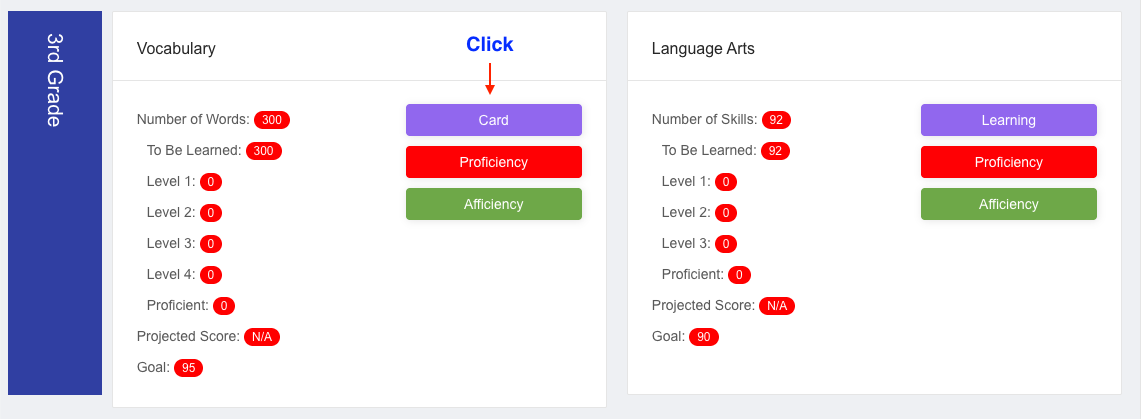
Vocabulary:
In the vocabulary section, one can simply click the ‘Card’ button (purple) to see a list of words arranged in alphabetical order.
Below is an example from the 3rd-grade curriculum. Clicking on the word flips the card that identifies the word’s part of speech, definition, and use of the word in an example sentence.
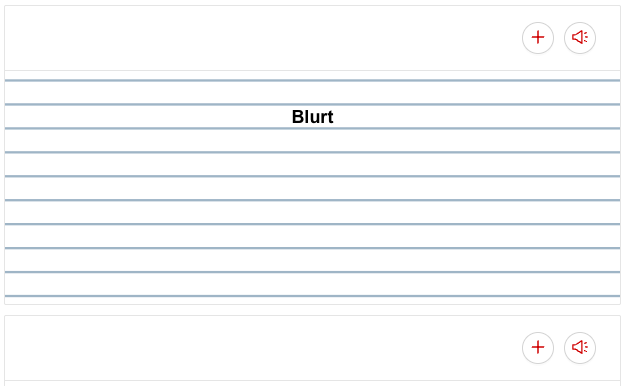

Clicking the red volume icon will read the word aloud, which helps students learn the correct pronunciation. This is especially helpful if the word is unfamiliar to the student. It is also extremely helpful for non-native English speakers.
In Grade 2 and above, students are exposed to 300 vocabulary words per grade level, and more in the answer choices. In completing multiple grades, students will be exposed to hundreds of words, their pronunciations, definitions, and usages.
Language Arts:
The Language Arts section provides a chapter view that visualizes all the skills organized by chapter within a grade level. Below is a chapter from the 3rd-grade curriculum.

Our AI-powered learning system automatically generates homework assignments in sequence, and students usually move through the chapters and skills starting at chapter 1. For this illustration, we have chosen Skill 8.5: Using Homophones (Language Skills) from Chapter 8.
Click on the ‘Learn’ button to open the lesson.
Demo:
In the top-right corner of the page, there is a ‘Demo’ button, and next to it is an icon for a video. Clicking the video icon opens a video window that can be enlarged. The video provides a detailed explanation of the demo. This is especially useful for auditory and visual learners, and students who are in the process of learning how to read.
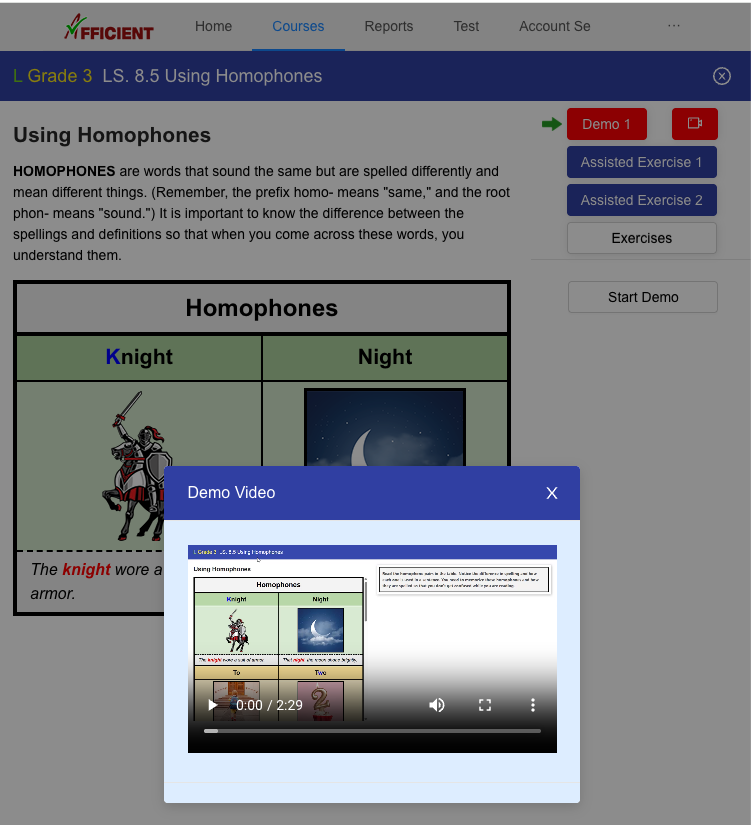
In the content window, there is a definition of ‘Homophones’ with an explanation and images that further help explain the concept. Also, below the images are sentences illustrating examples of homophones in sentences.
You can easily follow and self-learn the concept.
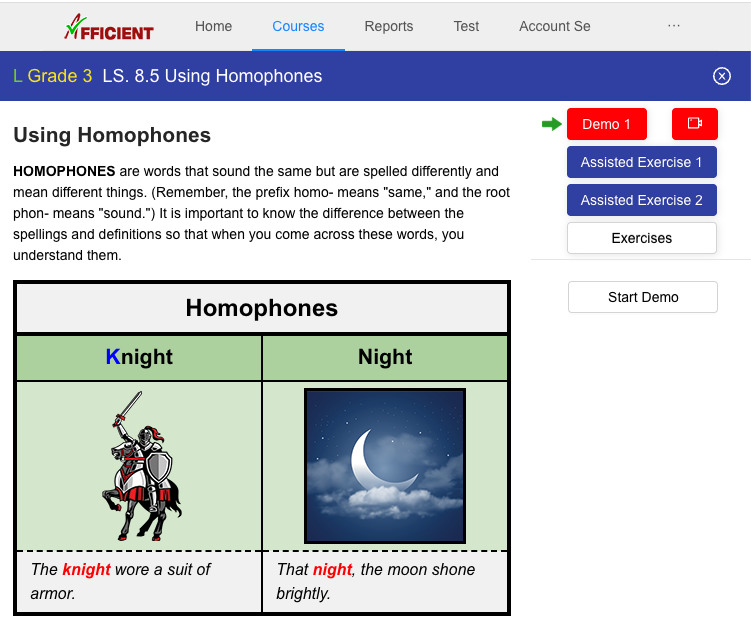
Assisted Exercises:
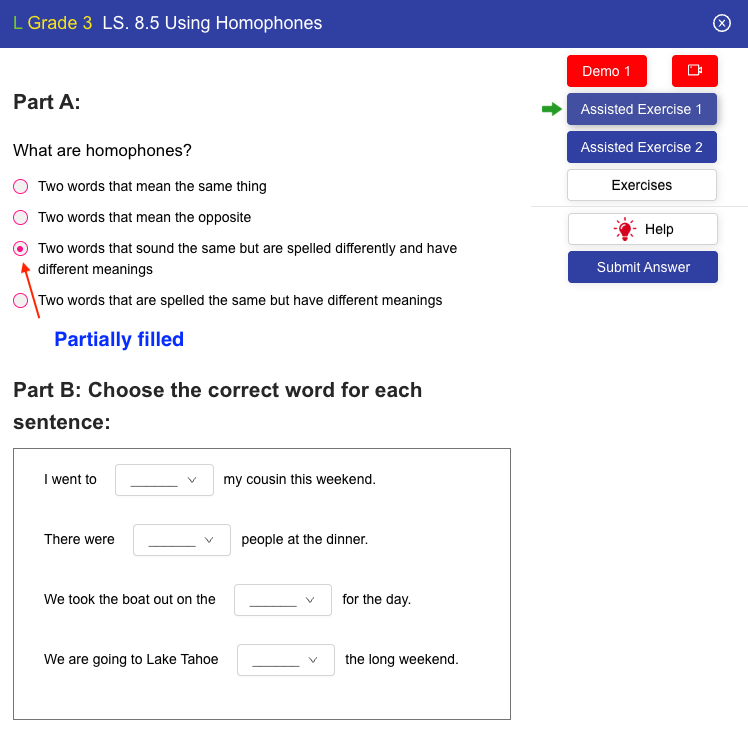
‘Assisted Exercises’ are partially filled and partially blank for the student to fill. This guided exercise further reinforces the understanding of the concept. In the illustration below, Part A is already selected, and Part B needs to be completed by the student.
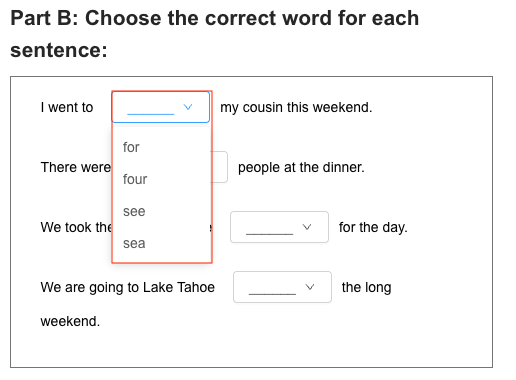
The drop-down menu provides choices, and the student needs to select the correct answer.
| If the student needs help, there is a ‘Help’ button with a light bulb icon; clicking it provides guidance to complete the exercise. (See the illustration below) |

In this skill, we have two Assisted Exercises. We strongly recommend that students complete both before attempting the independent exercises.
Exercises:
Let’s complete an exercise. Clicking on ‘Exercises’ opens the first question. To successfully pass the level, the student must get 5 correct out of 6 questions for language skills. If the student answers correctly, a green check mark appears next to the question. Also, there is a confirmation message saying ‘Correct’ in green below the buttons. The student needs five green check marks. To get the next problem, the student must click on the blue button that reads, ‘Next Problem.’
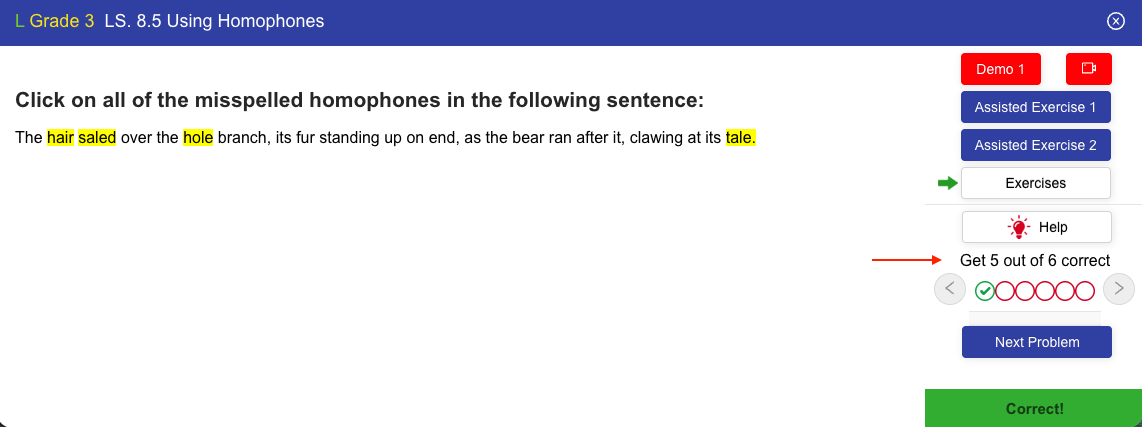
Following the above guidance, any student can self-learn English material and develop strong foundational skills in Language Arts. As mentioned earlier, students can seek help from our instructors during their availability hours and schedule sessions in advance to receive guidance.
Having a strong knowledge base and skills in English language Arts will not only boost grades in English but also help in other subjects like Science, History, Geography, and Social Studies, as well as any subject taught in English. It improves verbal and written communication and literary skills and benefits students beyond their academic careers. As Dr. Seuss, the famous American children’s author, said, “The more that you read, the more things you will know. The more that you learn, the more places you’ll go.”