
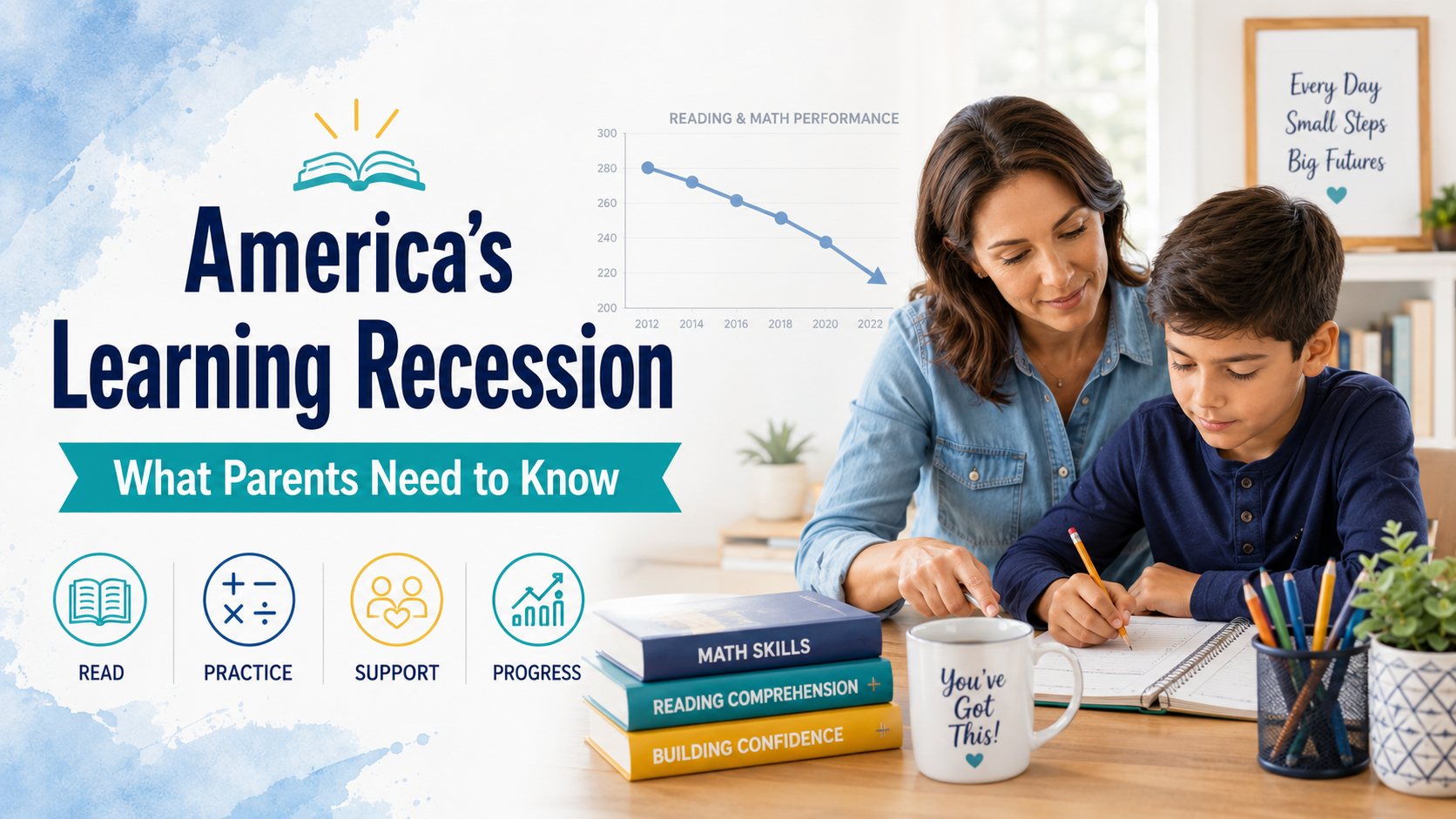
For many families, the phrase “learning loss” brings the pandemic to mind. School closures, online classes, disrupted routines, and social isolation affected students worldwide. But recent research suggests that America’s academic challenges began long before COVID-19.
Education researchers are now calling this pattern a “learning recession.” Just as an economic recession describes a period of decline in financial growth, a learning recession describes a sustained decline in student academic progress. The concern is not only that students fell behind during the pandemic, but also that reading and math achievement was already weakening for years, as discussed in this PBS video featuring the education researcher Thomas Kane.
According to researchers from Stanford, Harvard, and Dartmouth, student achievement in math and reading began declining around 2013, reversing roughly two decades of academic improvement. The pandemic did not create the entire problem; it intensified an existing one.
This distinction matters. If we believe the issue was only pandemic-related, then the goal becomes simply returning students to 2019 levels. But if 2019 was already part of a downward trend, then returning to pre-pandemic performance is not enough. Students need stronger, more consistent support to rebuild foundations, close learning gaps, and regain academic confidence.
Several factors may have contributed to this decline. Researchers point to changes in education accountability systems, rising student absenteeism, increased screen and social media use, and uneven access to effective academic support. Reading progress has been especially concerning. The 2024 Nation’s Report Card showed that fourth-grade reading scores were lower than both 2022 and 2019 levels, with only 31% of fourth graders reaching NAEP Proficient or above.
Math shows a mixed picture. Fourth-grade math improved slightly from 2022, but scores remained below pre-pandemic levels. Eighth-grade math remained significantly lower than 2019, suggesting that older students may face deeper and more persistent gaps.
For parents, the most important takeaway is this: learning gaps often grow quietly. A child may move from one grade to the next, complete homework, and even earn acceptable grades while still missing key foundational skills. In subjects like math and English, each grade builds on the previous one. If a student has weak math facts, grammar, vocabulary, reading fluency, or problem-solving skills, those gaps can make future learning more difficult.
This is why assessment should come before intervention. Parents should not have to guess where their child is struggling. A careful diagnostic test can identify whether the student is learning at the right level, which skills are strong, and which areas need targeted support. Afficient Academy’s own blog content emphasizes this diagnostic-first approach: wide skill gaps can hinder progress, and a diagnostic test can help identify essential gaps, generate an evaluation report, and guide a personalized study plan.
The solution is not simply more homework. Students need the right work at the right level. Effective learning recovery should include four elements:
First, students need to accurately identify learning gaps. Without knowing the starting point, families may waste time reviewing skills the child already knows or skipping over skills the child has not mastered.
Second, students need personalized practice. A one-size-fits-all worksheet or class may not address the exact skills a student needs. Afficient Math, for example, is described as an AI-powered, self-paced program that adjusts learning based on mastery level, weak areas, pace, and grade-level goals.
Third, students need strong reading and language development. Reading is not a single skill; it encompasses phonics, fluency, vocabulary, comprehension, and written response. Afficient English is designed around personalized learning, Science of Reading principles, instant feedback, and teacher supervision.
Finally, students need human guidance and accountability. Technology can personalize learning efficiently, but children still benefit from encouragement, explanation, coaching, and progress review. Afficient Math combines diagnostic-based placement, instant feedback, teacher and advisor support, and real-time progress tracking.
The learning recession is a serious national issue, but it is not hopeless. The research also shows that some states and districts are improving, especially where they use evidence-based strategies and focus on clear learning recovery. For parents, the practical next step is to act early: understand your child’s true skill level, systematically fill gaps, and build a routine that supports steady progress.
A child with a strong foundation is more likely to learn confidently, adapt to new challenges, and succeed in future grades. To better understand your child’s current math and English level, sign up for Afficient Academy’s Free Diagnostic Test and Consultation. An academic advisor can review the results and recommend a personalized learning path.
Sources:
https://youtu.be/Kt37k2mAXjs?si=niiaomzwKoqmUZ5p
https://ed.stanford.edu/news/us-student-achievement-was-falling-long-pandemic-study-finds
https://www.nationsreportcard.gov/reports/reading/2024/g4_8/